There’s a great new website about our solar system that will blow your socks off! The Planets Online introduces viewers to a broad range of subjects in a unique, innovative, and entertaining way. The site naturally interweaves information on science, engineering, music, visual design, and technology—it could be a showcase for STEAM education (Science, Technology, Engineering, Arts, and Math).
Adrian Wyard
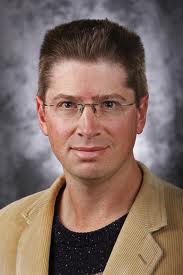
The site is the creation of visual artist Adrian Wyard. Followers of Seattle Astronomy may recall that we wrote about Wyard’s show The Planets Live about three years ago (story here). The concept is that Wyard uses images of celestial objects to accompany and enhance classical music. He’s done it with Gustav Holst’s The Planets, Mussorgsky’s Pictures at an Exhibition, and Dvorák’s 9th Symphony.
The core of The Planets Online is a video of a performance of The Planets by the Auburn Symphony Orchestra directed by Anthony Spain and featuring the Seattle Pacific University Women’s Choir and Wyard’s visuals. This is no ordinary video, however. If you remember when we used to get our video on plastic disks, think of The Planets Online as a video loaded with special features. As the video plays, a sidebar describes the images and who created them, offers facts about the music, pulls up Wikipedia pages and other sources about the science, throws in tidbits of trivia, and more. You can switch any of these info streams on or off depending on your interests.
Here’s a little preview video of The Planets Online.
We expect you might spend a good deal of time with the site.
There are live performances of Wyard’s work coming up this spring in Florida, Virginia, and Texas. The last northwest live performances were back in April, May, and October last year. If you missed those, you can have a little fun—and learn a few things—with The Planets Online.
A dreamy, musical astronomy show will return to its birth town of Seattle next week after more than a decade away. Starball, created by John Kauffman and Dan Dennis, will play at West of Lenin in Fremont from September 7–11.
According to the show’s Facebook page, “Audience members play villagers in a dystopian future in which the global government, or World Regime, has ended the relationship between humanity and the stars. But two Astronomasons, the Conductor (Kaufmann) and the Proxy (Dennis), have rebelled, calling the villagers to a secret clearing for a creative ritual.”
It sounds a little dark, but director Rachel Katz Carey and producer A.J. Epstein call it “giddy fun.”
Carey said Kauffman and Dennis were the perfect people to create this show.
“They’ve got charm and charisma for days and they’ve got improv experience and they’ve got huge, open hearts, so people just want to jump in and work with them,” Carey said. “They also have the hard science. They’re not just theater guys who thought they found a gimmick; they really, truly know their astronomy.”
Both were working at the Willard Smith Planetarium at the Pacific Science Center when they created and first performed Starball in 2002. In 2004 they brought in Carey and Epstein to help take the show to new places.
“What they needed was scaffolding to give some form and structure,” Carey said. “It’s been my experience that improv thrives the best when there is a scaffolding and structure to support it.”
In the intervening years Starball has been performed in Chicago, New York, Philadelphia, Baltimore, Baton Rouge, and even Spain. For its return to Seattle it will be performed in an inflatable planetarium on the West of Lenin stage.
Epstein explained that as audience members enter they will be asked to anonymously jot down notes about a recent dream. During the performance dreams will be drawn at random, and the actors and audience will look for parts of the dream in the stars projected on the planetarium dome. The audience and actors together will create stories based on the dreams identified in the sky.
L-R: Seattle Astronomy’s Greg Scheiderer, Starball producer AJ
Epstein and director Rachel Katz Carey in front of the inflatable
planetarium in which Starball will be performed Sept. 7-11
at West of Lenin. (Photo: Greg Scheiderer)
“By the end of the night we have an entirely new sky mythology, not just individual constellations but a mythology unique to that group of people,” Epstein said. “And then they write a song.”
“An original song for every show based on what’s shown up in the sky,” Carey added.
“A Jungian devotee would have a field day with this show,” Epstein laughed.
He laments that, as a culture, we’ve lost our connection to the night sky.
“Most of us now live in cities where we can maybe see a couple of stars,” he said, “so the show really is very loudly but very elegantly getting people to actually look up at the sky and make a connection.”
At Seattle Astronomy we like to explore the intersections of art and science. Some would set up a divide there, but neither Carey nor Epstein see it.
“That’s sort of a Mac/PC religion question!” Epstein laughed.
“The stars were art before they were science,” Carey said. “We’ve been telling stories about stars long before we had telescopes.”
“The best scientists and the best writers about science that I know absolutely have the connection to art and imagination,” Carey added. “How do you get the big discoveries if you can’t imagine ahead of your data and then do the work to see if it’s there?”
Both admit to bias because of their involvement, but insist that Starball is way different than any planetarium show you’ve ever seen.
“You just have to be there, and when you leave you’re different because you’ve figured some stuff out,” Carey said.
“This one really grabs an audience by the heart and brings them to a place where they get it,” Epstein added.
Starball runs at West of Lenin for seven performances September 7-11. Tickets are $20 and are available online. Early purchase is recommended because the planetarium will only seat around 40 people.
"Swimming Stars Plaza" is an art installation by Lezlie Jane in West Seattle's Whale Tail Playground.
Swimming Stars Plaza by Lezlie Jane Photo: Greg Scheiderer
"Swimming Stars" depicts the constellation Cetus, often called the sea monster or the whale; thus Whale Tail Playground (which is actually at the north end of Alki Playground near the intersection of SW Lander Street and Marine Avenue SW) is a fitting spot. Glass stars in the concrete mark the shape of the constellation, and other marine critters linger about as mosaics or imprints as well, and there's a big octopus on the scene. Click the photo above to get a bigger version!
Cetus is the vehicle in a great story of mythology, sent by Poseidon in revenge for an insult when Cassiopeia, wife of King Cepheus of Ethiopia, claimed to be more beautiful than the Nereids. An oracle told Cepheus that he could stop the sea monster from ravaging his coast by offering up his daughter Andromeda as a sacrifice. Fortunately for her, the hero Perseus happened by and saved Andromeda in the nick of time!
The constellation Cetus is visible in the sky from the site of the "Swimming Stars" installation just four months out of the year, starting in October when you can see it in the south at around 10 p.m. Show up about an hour earlier each month through January to spot it.
An astronomy device that had been damaged is back in operation, while a city-wide solar system model is, alas, showing signs of decay.
We reported back in August of last year that the Foucault pendulum in the Physics/Astronomy building at the University of Washington was out of commission. While the UW wasn’t saying specifically, we suspected the damage may have been caused by people not well versed in engineering trying to take a ride on the pendulum.
We’d noticed construction happening at the pendulum on some visits to campus in late winter and early spring, and we’re happy to report that it’s back in the swing of things again.
Back in February we told you about a fun project out of Three Dragons Academy, an arts program for elementary-aged children. The students created a scale model of the solar system, a city-wide art installation in which the Sun is an 18-foot circle painted and chalked onto the south plaza of the University Heights Center at NE 50th Street and Brooklyn Avenue NE. Uranus, at this scale, was down on Alki beach, not far from Seattle Astronomy headquarters.
On a recent trip to the U-District we stumbled upon Mercury, which is, in an interesting twist, right outside Neptune Music. Since we were so close, we sought out the Sun and found it still as advertised at the center. That’s the University Heights Center, not the center of the universe. As Copernicus discovered, that’s in Fremont.
Mercury is a little worse for wear, given nearly half a year out in the elements. Uranus has vanished from Alki; perhaps it’s moved along in its orbit!
Some of the most visionary space and science fiction art from the 1950s and ‘60s is on display at Pivot Art + Culture. The exhibit, Imagined Futures: Science Fiction, Art, and Artifacts from the Paul G. Allen Family Collection, will be on view through July 10 at the gallery on the ground level of the Allen Institute Building on Westlake Avenue in the South Lake Union neighborhood of Seattle.
Even if you didn’t grow up in the decades before the exploration of space became a reality, you’ve probably seen a lot of these pieces, which were featured in such magazines as Colliers, The Week, and Life, and often graced the covers of sci-fi books of the time.
The exhibit relies heavily on the works of two giants of the genre, Chesley Bonestell and Fred Freeman, but also features the works of more than two dozen artists from both the early decades and more recent times. Bonestell and Freeman weren’t entirely making up their images. Both worked closely with Wernher von Braun, who had significant input into the future of space and rocketry, and one of the great aspects of the exhibit is that it includes some preliminary artist sketches of the works with handwritten commentary from von Braun.
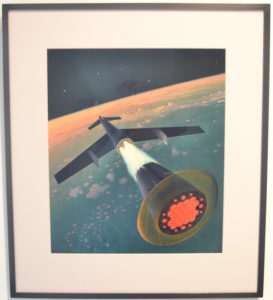
Separation of the Third Stage of the Manned Ferry
Rocket 40 Miles Above the Pacific Ocean, a
1952 painting by Chesley Bonestell, is part of
the Imagined Futures exhibit on display at Pivot
Art + Culture in Seattle. Photo: Greg Scheiderer.
One of the most iconic pieces in the exhibit is Bonestell’s Separation of the Third Stage of the Manned Ferry Rocket 40 Miles Above the Pacific Ocean, painted in 1952. It’s likely a familiar image to many space cadets. It was used on the posters advertising the exhibit, and was first used as a cover for the series, “Man Will Conquer Space Soon,” published by Colliers in March 1953. While the painting is not precisely prescient, von Braun’s notion of a multi-stage launch vehicle eventually became a reality as the Saturn V, and the reusable space plane was a precursor of the space shuttle. The exhibit includes not just the painting and the sketches that informed it, but a 1:48 scale model of the space vehicle that was produced for a 1955 Disney show Man and the Moon as well.
Movies and TV are represented in the exhibit, which includes vintage movie posters from Destination Moon and War of the Worlds, MGM stills from 2001: A Space Odyssey, and a model of the agridome that was used in the film Silent Running as well as in the original 1970s version of the television series Battlestar Gallactica.
With a lot of cool stuff in the gallery, one piece does its darndest to grab all of the attention. That is a huge charcoal sketch of Saturn by Robert Longo that is around five feet tall and ten feet wide.
The exhibit also features an X-15 engine and an IBM System 360 computer.
The exhibit is open from 10 a.m. until 6 p.m. Tuesday through Sunday, and stays open until 8 p.m. on Thursdays. Admission is just $5. Curator Ben Heywood leads tours of the exhibit beginning at 12:30 p.m. on Wednesdays. It’s cool stuff and well worth a look for space and sci-fi buffs.
Henrietta Leavitt blew up the universe. It’s amazing that so few people know about her. The numbers of the informed grow with each performance of Silent Sky, a play by San Francisco-based playwright Lauren Gunderson running through this weekend at Taproot Theatre in Greenwood.
Leavitt is the early 20th century Harvard Observatory astronomer who, while examining and cataloging photographic plates of stars, discovered the relationship between the luminosity and the period of Cepheid variable stars. This breakthrough enabled astronomers to calculate the distances to these stars, some of which turned out to be at vast distances from Earth. What were then called spiral nebulae were actually other galaxies and not part of our own Milky Way. The universe suddenly became a far, far bigger place.
The play, directed by Karen Lund at Taproot, explores Leavitt’s life as she moves away from home to work at Harvard, examines the struggles she and her colleagues faced as women in astronomy, and delves into the ways in which art and faith influenced her life and work. There’s also a sad tale of love.
Hana Lass as Henrietta Leavitt in Taproot Theatre’s Silent
Sky, running through Feb. 27. Taproot photo.
The show features five actors, and all did a marvelous job. Hana Lass played Henrietta. Kim Morris played Willamina Fleming, who was actually the housekeeper for Harvard Observatory director Edward Pickering until he hired her, at a pittance of a wage, as a human computer to measure and catalog the brightness of stars on the observatory’s photographic plates. Nikki Visel played Annie Cannon, another computer who developed the stellar classification system still in use today. Candace Vance played Margaret Leavitt, Henrietta’s sister. Calder Jameson Shilling portrayed Peter Shaw, an assistant to Pickering and a faculty member at Harvard.
Toiling in obscurity
Even many people close to astronomy did not know of Leavitt.
Director Karen Lund and Adrian Wyard of the Counterbalance
Foundation drew a large and engaged crowd to Taproot Theatre
on a recent Tuesday for a discussion about Silent Sky and
the interplay between science and faith. Photo: Greg Scheiderer.
“I am a historian of science and had never heard of any of these people,” said Adrian Wyard, director of the Counterbalance Foundation, a Seattle-based nonprofit educational organization working to promote the public understanding of science and how the sciences relate to wider society. We did a story about our interview with Wyard earlier this month, in which we discussed the interplay between art, science, and faith. Taproot held a conversation at the theater last week for discussion of similar topics as they relate to Silent Sky. Wyard gave the play a nod of approval, noting that it was highly entertaining and that the science was right on.
“It’s so rare to see great art where the science is represented faithfully,” he said. “Henrietta Leavitt played a major role in an important discovery in the 1900s. It’s fair to say that she blew up the universe.”
Telling the story of Silent Sky
Lund, the director, said that the actors did extensive research about the people they were to portray, and turned up some facts that were not depicted in the play. For example, both Henrietta Leavitt and Cannon were hearing impaired, but only Leavitt was depicted as such for Silent Sky. Lund pointed out that the playwright Gunderson really captured the personalities and the times.
“It’s beautiful, in a composite way, how accurate she is,” Lund said, adding that their own research helped a great deal. “We use the information that we gather as a way of supporting the characters that we build and create.”
The set pieces of the work stations the computers used are faithful reproductions of the gear the women used at Harvard more than a century ago. Lund also brought in an astronomer from the University of Washington to talk the cast through the science of the play, which Lund said was a rewarding day of rehearsal.
“We wanted to be able to speak with authority as those characters,” she said.
Science, faith, and art
Faith came into the story because Leavitt was the daughter of a Congregational minister, and art entered because Henrietta was inspired to recognize the patterns of the Cepheids in part because there were similar tonal relationships in her sister’s piano playing. Art informed and nurtured the scientific mind.
Wyard pointed out that there are some pretty bright lines around what science is supposed to do.
“The job is to understand the natural world that we can measure, and to establish mathematical theories which could be falsifiable,” he said, adding that science must tackle some pretty narrow questions. “Purpose and meaning and value are things we need to eject from science if science is going to do a good job.”
Silent Sky is excellent theater, and one need not be interested in astronomy to enjoy the story. The performances and the staging are grand. Sadly, this is its last weekend, with the final performance on Saturday. We also enjoyed another Gunderson play about women in science, Emilie: La Marquise Du Châtelet Defends Her Life Tonight, which was produced at ArtsWest in West Seattle in 2011. Emilie was a major force in early 18th century math and physics.
The Luna Girls on Alki sculpture can be found along the Alki Trail just a short distance south of Seacrest Park. Photo: Greg Scheiderer.
Luna Girls on Alki is an astronomically named sculpture just south of Seacrest Park along the Alki Trail in West Seattle. The Luna Girls, nine-foot-tall bathing beauties cut from slab steel, were created by local artist Lezlie Jane, who also had a hand in Constellation Park and the Avenue of Stars that we featured in a post back in December. The Luna Park amusement park at Duwamish Head was open from 1907 until 1913, though the attached swimming pools operated until 1931. The Luna Girls in their twenties beach attire continue to welcome visitors to the neighborhood.
If you'd like your own Luna Girl, or the entire trio, 20-inch-tall replicas can be purchased at Alki Arts gallery.
These days many folks would have the sciences go it alone. Education advocates repeat their mantra of STEM, STEM, STEMMMM while schooling in the arts is reduced or eliminated. Some scientists decry the so-called magic of religion. People of faith shun science because God is the answer. Adrian Wyard—software engineer, artist, astronomy buff, and Christian—believes science, art, and faith get along just fine.
Adrian Wyard
“As a child I always had those three elements in my life,” Wyard said in an interview earlier this month. “I grew up going to church back in England, I had a strong science and engineering interest, which sent me on a straight line into computer science, computer software design. That was my first career.”
Wyard fesses up to a certain level of single mindedness about computers in his youth.
“I had very little time for anything else,” he said, though he had some interest in art in high school, and that crept into his work.
“There was always a design element,” he said. “I was never that good at coding but I loved the big picture, I loved solving problems for real people, so I ended up focusing on designing user interfaces.”
He was the program manager for Word 1.0 at Microsoft.
“I was lucky enough to be there when all the good stuff happened at the beginning,” Wyard said. “That took a lot of my time,” he added in something of an understatement.
Changing course
After leaving Microsoft Wyard decided to reboot and attended Seattle Pacific University.
“I went to SPU to essentially do exactly the opposite of what I did the first time. So I took liberal arts, I took theater, I took English, I took sociology,” he said. “I just got totally enamored by these connections between different disciplines.”
Wyard wanted to learn more about those connections. The research was out there, but it was hard to find. He started the Counterbalance Foundation in 1998 as essentially an online library exploring the intersections of science and faith. The site now has in the neighborhood of 300,000 links and 200 hours of video. The site helps readers of multidisciplinary texts find resources to understand the particular disciplines with which they may be less familiar, and facilitates discussion and education.
“The idea of using interactive technologies to teach, to help people understand multidisciplinary subjects, just struck me as an obvious move,” Wyard said. In a way, he sees counterbalance as penance for his lack of multidisciplinarianism as a youth.
“The one subject I disliked the most was history, because as far as I was concerned everything happens starting with Turing in 1950 or thereabouts, and that’s it, and I did not want to be distracted from my main interest,” in computers, he said. “Counterbalance is basically me coming to realize the error of my ways.”
He also overcame his dislike of history, eventually going to Oxford to earn a master’s degree in the history of science, studying under John Hedley Brooke. While at Oxford Wyard specialized in the study of the tension between creation and evolution. His adult education gives him a better foundation from which to approach these knotty questions.
A search for the truth
Many people like to depict science and faith as warring factions, but Wyard sees both as having the same goal of seeking the truth.
“There is no religious person, as crazy as they may appear to other religious people, or atheists or scientists, who does not in their heart of hearts want to find what’s true and would be horrified to think that they were being misled. That will forever bind the religious inclination and the scientific inclination,” Wyard said. “On balance, what you find is just a compulsion to find out the way the world works, and almost always be in awe of that. There’s so much common ground, it’s hard to imagine it ever conflicts.”
Yet it almost has to at times. The tension between science and religion is a complicated one, Wyard said.
“If you want to talk about all the sciences and all of the religions, you can easily find examples among that huge landscape, of overt conflict, where one says this is the case and the other says the opposite,” he said.
Conversation at Taproot
Wyard will be giving a public presentation to discuss these ideas at 7:30 p.m. Tuesday, Feb. 16 at Taproot Theatre in Greenwood. The theatre is running Lauren Gunderson’s play, Silent Sky, about the Harvard astronomer Henrietta Leavitt. The drama tackles some of these same questions, and Wyard said he’s been thinking about delving a little into postmodernism for the conversation.
“Sometimes that can be a rabbit trail that you really don’t want to go down,” he said of postmodernism. “For some people it’s a keyword for a lot of troubling things.”
But Wyard said that the modernist concept of knowledge, which was very much in play during the time in which the play is set in the early 20th century, held that knowledge accumulates, you reach a conclusion, and then you have the answers. Religion, he noted, sometimes operates in much the same way.
“At least what postmodernism has done is show that in the sciences, that does not work,” he said. “There are precious few lines of scientific inquiry that don’t require you to also understand the perspective” of which questions are asked and the context in which any experiment is being conducted.
Postmodernism, Wyard said, “recognizes that science exists in a socioeconomic political framework, and there is nothing that happens that doesn’t have some connection through to economics or politics or even just social mores and preferences.”
Learning more
Wyard suggests a couple of books that may be of interest to people wishing to delve into this line of inquiry. One is The Language of God: A Scientist Presents Evidence for Belief (Free Press, 2007) by Francis Collins, who was lead of human genome project and is chair of the National Institutes of Health.
“That is a nice introduction because he takes us on the journey throughout his own story, which starts off as an athiest” though now Wyard said Collins identifies as evangelical. “He goes all the way through without losing any speck of his scientific interest and aptitude.”
The other book isIncomplete Nature: How Mind Emerged from Matter(W.W. Norton & Company, 2013) by Terrance Deacon, an anthropologist and neuroscientist at Berkeley. Wyard said it’s a fascinating book, though a bit of a heavy lift at more than 600 pages. He is working with Deacon and his research team to try to bring it to a more accessible level. There are a couple of lectures about the book in Counterbalance’s Bridging the Gaps section.
The Planets Live
Wyard started doing art again about five years ago. He is getting into greater touch with his artistic side, collaborating on a multimedia presentation of Gustav Holst’s composition The Planets. The work, which Wyard describes as a live, choreographed video accompaniment of the piece, was first performed in 2014 at the Highline Performing Arts Center as a project with the Northwest Symphony Orchestra. It hit all the right notes with Wyard, “combining my knowledge of computers, computer technology, space, and also the photography side came in too,” he said.
While The Planets Live stands on its own as art—see the trailer below—Wyard is also excited about it as a “killer educational tool.”
“The Planets suite is a very accessible piece of music,” he said, noting that even kids who came in thinking that classical music is boring dug it at the premiere.
“They loved it because not only were the visuals interesting and stimulating, but it allowed them to access the music,” Wyard said. “It was a positive introduction to classical music, plus an introduction to astronomy.”
They did several other performances of the work in Sioux Falls last year with the South Dakota Symphony Orchestra, one of which was recorded and later aired by PBS. Several other performances are on the schedule for this year Lakeland, Fla. and Ann Arbor, Mich., and Wyard said they hope to bring The Planets Live back to the Seattle area again sometime soon, though this has not yet been set.
Adrian Wyard is an interesting person taking on some big questions. We expect you’ll hear more from him on Seattle Astronomy.
While walking along Alki Avenue in West Seattle today I encountered the planet Uranus. Not the actual planet—that would create some unpleasant conditions—but an artist’s representation that is part of a scale model of the solar system created by kids at the Three Dragons Academy, an arts-based alternative for elementary-age children.
This sandwich board along Alki Avenue
SW marks the location of Uranus in the
scale model of the solar system created by
students at Three Dragons Academy. Their
Sun, 18 feet in diameter, is outside the
University Heights Center 7.3 miles
away. Photo: Greg Scheiderer.
Last month the students, aged five through 10, studied painting and scale. This city-wide art installation is the result of their work. The Sun is an 18-foot circle painted and chalked onto the south plaza of the University Heights Center at NE 50th Street and Brooklyn Avenue NE. At that scale Uranus is about eight inches in diameter, and is at 58th Avenue SW and Alki Avenue SW, in front of Coastal Surf Boutique, across the street from Duke’s Chowder House, and just a block away from Astro BizBlue Moon Burgers. That places Uranus about 7.3 miles from the Sun as the crow flies, at least according to the Google Maps measuring tool. The scale of the model solar system is about 1:253,718,000.
At that scale Mercury, just three-quarters of an inch in diameter, is a mere six blocks away from the Sun at 50th and Roosevelt. All of the other planets are represented, too, and, bless them, the students have even included some dwarf planets. There are a couple of one-third-inch Plutos out there, one up at Paine Field in Everett and the other in Des Moines. Ceres is on the University of Washington campus, fittingly enough near the Physics/Astronomy Building.
They’re already at work on figuring out the recently speculated upon Planet Nine, which is thought to have a highly irregular orbit. At its closest might be around Portland and at its furthest somewhere near Missoula, Montana. They’re not planning to make that trip to place a painting!
You can read more about the project on the Three Dragons Academy website and probably find a planet near you. Visit one or visit them all!
We love it when science and art meet, and its going to happen this month when Lauren Gunderson’s play Silent Sky, directed by Karen Lund, has its Northwest premiere from Jan. 27 through Feb. 27 at Taproot Theatre in Greenwood.
Silent Sky is the true story of Henrietta Leavitt, the American astronomer who discovered the relationship between the luminosity and the period of Cepheid variable stars. Her work at Harvard College Observatory received little attention during her lifetime, which spanned 1868–1921, but her discovery was the key to our ability to accurately determine the distances to faraway galaxies. Silent Sky plays out against a landscape of fierce sisterly love, early feminism, universe-revealing science, and a time when humans were called “computers.”
Lauren Gunderson
Gunderson is a marvelous playwright who lives in the San Francisco Bay Area. We have seen several of her other plays, including Émilie: La Marquise Du Châtelet Defends Her Life Tonight, the fascinating tale of Émilie Du Châtelet, the 18th-Century French physicist who not only translated Newton’s Principia Mathematica but also made profound contributions in fine-tuning Newtonian mechanics. Émilie usually bested Voltaire, one of her lovers, in battles of wits. We reviewed the 2011 production at ArtsWest in West Seattle and enjoyed it immensely. Silent Sky promises to be entertaining and enlightening as well. The cast includes Hana Lass, an outstanding local actor, in the title role.
Tickets to Silent Sky are available online.
We at Seattle Astronomy are not into astrophotography as such; while we enjoy the images created by others, our own interests in amateur astronomy lean strongly toward visual observation. Nevertheless, we have been known to do a little shutterbugging from time to time, and thus Photography Night Sky: A Field Guide for Shooting After Dark (Mountaineers Books, 2014) is an interesting read.
Authored by Jennifer Wu and James Martin, Photography Night Sky is not a guide for deep-sky photography, but rather a primer for shooting nightscapes, including stars, the Milky Way, star trails, the Moon, and twilight scenes. Wu and Martin also cover meteors, aurorae, false dawn, and other celestial phenomena.
The 100 gorgeous color photos included in the book are proof enough that the authors know what they’re talking about. They have the credentials to back it up, too. Wu has won a bevy of awards for her work and is a Canon “Explorer of Light” photographer. Martin has written and photographed professionally since 1989 and is the author of several books, including the best-selling Photography Outdoors: A Field Guide for Travel and Adventure Photographers, which had a new release last year.
Photography Night Sky is a highly accessible guide for the novice shooter, and we expect seasoned photographers also will find some good pointers within. Wu and Martin cover equipment and preparation for shooting, and get into such topics as composition, focus, and optimum camera settings for various conditions. They also address some of the challenges of photography at night, especially shooting in the cold. The book includes chapters about the various sorts of objects one might shoot in the dark, and a full chapter about post-processing of images.
We were especially interested in the sections about lighting and the methods, such as light painting, for enhancing the appearance of objects at night without washing out the stars you’re trying to capture in your images.
Wu was in Seattle to give a talk last month, but we had to miss it, as it was scheduled at the same time as a lecture by renowned cosmologist Jim Peebles. But we’re glad to have a copy of Photography Night Sky, and hope the advice from Wu and Martin will help improve our own imaging. Pick up a copy at the link or by clicking the cover photo above.
Seattle Astronomy was excited to get a note over the weekend announcing that the Battle Point Sundial Project is nearing completion. The Battle Point Astronomical Association (BPAA) reports that its spectacular, 12-foot-tall equatorial bowstring sundial should be installed near its Edwin E. Ritchie Observatory in Battle Point Park on Bainbridge Island within the next few weeks, depending on the delivery schedule of the sundial’s fabricator.
The foundation is prepared for the Battle Point Astronomical Association equatorial bowstring sundial. From L-R: Dylan Sievertson (PHC Construction, built the foundation); Nels Johansen (BPAA Vice Pres); David Browning (Sundial Engineer); Bill Baran-Mickle (Sundial Artist/Designer). Once the foundation was aligned and leveled, more concrete was poured around it to lock it in place. The Edwin E. Ritchie Observatory is in the background. Photo: Malcolm Saunders.
The BPAA has had this project on the drawing board for a long time. After slowly collecting funds over the years at their planetarium shows and other events, they reached a critical mass two years ago. Committed volunteers started to drive the project, and in late summer of 2013 they launched an Indiegogo campaign to raise $17,000 to bring their kitty up to the $30,000 they needed to build the sundial and install it in the park. The campaign drew some 75 donors, including Seattle Astronomy, and though it fell somewhat short of its goal, the attention the campaign attracted drew other outside funding, including a $1,000 grant from the North American Sundial Society, and BPAA amassed enough cash to move ahead with the project.
Their original goal was to have the sundial installed and dedicated by last spring, but they ran into some delays as sometimes happens with construction projects. They’re on track now with the foundation in place and ready for sundial delivery, and the sundial itself is fabricated and painted and ready to roll.
The sundial will be more than just a celestial timepiece. It will be a work of art and a conversation starter, and it will be a focal point for the BPAA’s facilities, which include the Ritchie Observatory, home of the 27.5-inch Ritchie Telescope and the John H. Rudolph Planetarium.
“I am passionate about sundials,” says Woody Sullivan, professor of astronomy at the University of Washington. “I have a goal to turn Seattle into the sundial capital of North America.”
Most of us don’t think of Seattle as the capital of anything related to the Sun, and we’re especially grumpy about it in the midst of a relentlessly gloppy March. But Sullivan points out that the second half of our year has long, clear days, and he observes that while people in, say, Phoenix often seek to escape from the Sun, we celebrate it.
“In Seattle, when the Sun comes out you go running out to see your sundial!” Sullivan says.
Sullivan gave a talk titled “Sundials Around Seattle and Beyond: Fascinating Mixtures of Astronomy, Art, Design, and History” at a recent meeting of the Eastside Astronomical Society in Bellevue. While the designation of sundial capital is hardly an official one, Sullivan thinks Seattle is on the way because of its large collection of interesting, well-cared-for public sundials.
The sundial on a SW-facing wall of the University of Washington
Physics/Astronomy building was the first Sullivan helped
build and design, 20 years ago.
Sullivan’s academic interests include astrobiology, the search for extraterrestrial intelligence, and the history of astronomy. His passion for sundials came about almost by accident. When the UW was constructing a new physics/astronomy building in the early ’90s, he suggested that a sundial should be placed on one of its large, outside walls. The architects went for it, and Sullivan spent a couple of years supervising the design and installation of the sundial.
“This is what got me into sundials, and ever since my life has been changed,” he says.
Inspired by the design of a sundial at the Sorbonne in Paris, the UW dial is on a wall that faces southwest. That means it’s design is asymmetrical, “which I think is more interesting from an aesthetic point of view,” Sullivan says.
Sullivan notes that all good sundials have a motto, and the one for the UW dial is “What you seek is but a shadow.”
“I thought that was good for a university,” he says. “It feels like it’s making progress.”
In a nod to our northwest weather the dial also is inscribed with a little poem:
I thrive on the Sun Can’t work in the rain So if I’m beclouded Please come back again.
If you visit a Seattle sundial you will notice that the it doesn’t agree with your watch.
“Sundials do not tell you clock time,” Sullivan explains. “Your watch is off because we keep the same time as the people in Spokane. That ain’t right! Solar noon”—the moment when the Sun is due south and highest in the sky—”happens there 20 minutes before it happens here.”
Sullivan helped design pancam calibration targets like this
one that also serve as sundials on the three rovers on Mars.
Sullivan gave us a look at numerous other sundials in the area, and he’s had a hand in the design and construction of many of them. They’re in parks and at schools and even on picnic tables. He supported the Battle Point Astronomical Association in its successful effort to fund a new sundial on Bainbridge Island which is scheduled to be completed this summer.
In addition to all of those here on Earth, Sullivan also helped design three sundials that are now on Mars. The rovers Spirit, Opportunity, and Curiosity all have targets that are used for color calibration of their cameras in light and in shade. Bill Nye the Science Guy, who is now CEO of the Planetary Society, saw a mockup of the target, a disk with a post in the middle of it, and immediately thought it should be a sundial. Nye got Sullivan involved in the design. Coincidentally, Tyler Nordgren, astronomer who keynoted the Seattle Astronomical Society‘s annual banquet in January, was also part of the team that put it together.
Woody Sullivan brought a variety of small sundial samples to his talk,
and the conversation continued well past the end of his formal presentation.
There’s also a bit of baseball on the Red Planet. As Sullivan and Nye share a passion for baseball in addition to their love of sundials, they made weight-saving cutouts in the bases of the Mars dials in the shape of home plate. Seattle’s Museum of Flight has Sullivan’s copy of the Mars dial on display in its space gallery.
Sullivan’s talk was tremendously well received. One EAS member noted that she switched her scheduled night at the opera to be at the talk instead. Staff at the library at which the talk was held booted us out well after closing time, and even at that the discussion continued in the parking lot for a good 45 minutes more.
Check out Sullivan’s sundial trail website for a guide to visiting Seattle sundials. Other reading:
Nordgren, a professor of astronomy and physics at the University of Redlands in California, pegs his early interest in astronomy to his suburban-Portland grade school principal, who happened to be the uncle of astronaut Bonnie Dunbar. Mr. Dunbar used his connections to bring NASA folks to the school for talks. Nordgren decided then that he wanted to be an astronaut, too. Then he was amazed by Carl Sagan’s TV series.
“When I saw Cosmos I realized why I wanted to be an astronaut, or if not an astronaut, to be an astronomer,” Nordgren said.
Coincidentally, Nordgren attended graduate school at Cornell University when Sagan was on the faculty. He never took a class from Sagan, but in one of his first teaching gigs Jeremy Sagan, Carl’s son, was in Nordgren’s class. He said Jeremy sat in the front row, asked a lot of questions, and then talked over the lectures with his famous dad. No pressure there.
“I learned to be on my toes!” Nordgren joked.
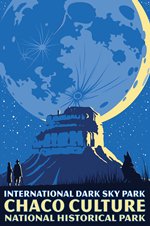
Nordgren’s posters like this one for
Chaco Culture National Historical Park
help call attention to the importance
of dark night skies in the parks.
A couple of events inspired Nordgren’s work in the national parks, which includes marvelous photography and a series of travel posters based on the style of the 1930s WPA graphics. The first was a visit to Palomar Observatory.
“My very first telescope was an eight-inch Celestron my father bought for me when I graduated from college,” Nordgren recalled. “My second telescope was the Palomar 200-inch” which he used in research about dark matter in spiral galaxies. When he returned 10 years later he was taken aback by the increased light pollution fueled by a housing boom in the area.
“It had been like a tidal wave of light had just swept out around the mountain,” he said. “It was stunning just how bad the skies now were at Palomar.”
Shortly after that trip, Nordgren celebrated gaining tenure by taking a trip to Yosemite National Park and attended an evening ranger talk about astronomy.
“For many, many people this was the first time they had seen a night sky, a truly pristine night sky,” Nordgren marveled.
He decided to spend an upcoming sabbatical in the National Park system helping rangers develop programs for park visitors to experience the night sky. He spent time in a dozen different parks over the course of 14 months, and came to realize that the preservation of the land that prevents development in the parks also, almost by accident, preserves the precious resource of truly dark skies. It’s a growing part of the appeal of the parks, articulated by the slogan “Half the park is after dark.”
“In those parks that offer night-sky programs the attendance they have is equal to if not better than the next two types of programs added together,” Nordgren noted. “Far and away these are the most popular ranger programs that are offered.”
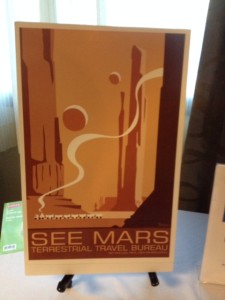
Nordgren's Mars poster
Much of Nordgren’s work is to link what people can see in the sky to what they see in the national parks. For example, he compares Mars to parks in the American Southwest; both Earth and the Red Planet have similar geology and chemistry. Yellowstone National Park has numerous geysers, similar to those on Saturn’s icy moon Enceladus.
“People paid attention to the sky, people have been doing that for centuries, millennia,” Nordgren said. “Unfortunately we’ve made it tremendously difficult to keep doing that.”
As evidence he showed a photo of the sky above Chaco, which is still impressively dark and starry, but all around light pollution is encroaching from the cities of Gallup, Crownpoint, Albuquerque, and a nearby coal mine. Thus a big part of his aim is to get communities near the parks to recognize that the night sky is an attraction, and to encourage them to be good stewards of the dark sky. His spiel goes just as well for any city, regardless of its proximity to a national park.
“All that light that shines above the horizon doesn’t do anything useful,” Nordgren said. “So why are we lighting up the sky? There is nothing we need fear up there, so why are we paying for that light? Why are we generating that light? Why are we burning the natural resources to create that light?”
There really aren’t great answers to those questions, and Nordgren said the solutions are within reach.
“This can be a win-win situation for all of us,” he said. “We can get the stars back, we can save money, we can save natural resources. It really doesn’t have to be stars versus safety.”
A sundial project that the Battle Point Astronomical Association (BPAA) has had on the drawing board for years will become reality by summer if all goes as planned. A fundraising effort anchored by an Indiegogo campaign has been a success.
“We’re only about $150 short of where we need to be, so on the strength of that we’re moving ahead,” said Frank Petrie, a BPAA member who is heading up the sundial effort. “It’s a done deal.”
BPAA members, with artist Bill Baran-Mickle at the center, pose with a model of the proposed sundial. BPAA photo.
Interestingly, the Indiegogo campaign fell well short of its goal, raising just $6,610 of the $17,000 needed to meet the project budget of about $30,000. Petrie said, however, that the campaign helped raise the overall visibility of the sundial project.
“A lot of donations came in outside of Indiegogo,” he said. “Even though we fell well short of our Indiegogo goal, all of this other money coming in outside of Indiegogo was able to bring us to the point where we successfully funded the project.”
The North American Sundial Society chipped in with a grant of $1,000 and several other significant private donations also were made.
“It was really gratifying to see how people stepped up and really got enthusiastic about the project and supported it,” Petrie said.
He gave a big nod to University of Washington astronomy professor Woody Sullivan, known in some circles as “Mr. Sundial.” Sullivan appeared in the video supporting the sundial campaign and also connected BPAA with the Sundial Society.
Bainbridge Island sculptor and metalsmith Bill Baran-Mickle is finalizing the design for the equatorial bowstring sundial, which will stand 12 feet tall. Petrie said the next steps are some engineering for the foundation for the sundial, which will be erected in Battle Point Park near BPAA’s Edwin Ritchie Observatory, then building the foundation, fabricating the sundial, and installing it.
“We hope to complete all that process by late spring, so hopefully we can have a dedication in late spring or early summer,” Petrie said.
Petrie added that additional contributions would be welcome. There’s a long-term plan to build a plaza at the sundial site, but that if enough donations are made in the coming months they could speed up the time line on that. Contributions can be made by check or online at the BPAA website. Earmark any contributions for the sundial project.
Petrie admitted that the original goal was pretty ambitious.
“It was a little daunting, but I’ve been really gratified. The Bainbridge Island community is good that way. They get excited about stuff like this,” Petrie said, adding that it wasn’t just islanders. “The response has been pretty overwhelming from all over. That’s been really nice.”
We look forward to attending the dedication of the sundial next summer if all goes as planned.
The shadow is moving on the Battle Point Astronomical Association (BPAA) as it seeks to raise the funds needed to build a large equatorial bowstring sundial near its Edwin Ritchie Observatory in Battle Point Park on Bainbridge Island. With a week left in the association’s Indiegogo campaign, they’ve raised $4,535 toward the goal of $17,000 needed to fully fund the project.
BPAA members, with artist Bill Baran-Mickle at the center, pose with a model of the proposed sundial. BPAA photo.
BPAA is actually a bit closer to the target than that. Frank Petrie, a BPAA member and part of the sundial committee, says they’ve raised more than $3,000 outside of Indiegogo since they launched the campaign about a month ago. Positive coverage of the effort has no doubt helped; in addition to our Seattle Astronomy article, the sundial project has received notice from the Bainbridge Island Review and Kitsap Sun. A contribution of $1,000 came in from the North American Sundial Society, which features a story about the BPAA effort on its website.
The budget for the sundial is $30,000. With previously received donations and contributions that have come in during the Indiegogo campaign, Petrie says they’re now within $10,000 of making the sundial a reality.
Even if they don’t reach the Indiegogo goal, they’ll receive funds pledged (less Indiegogo’s cut), and Petrie says they’ll bank that and take on other fundraising efforts until they have enough.
Why not resolve that worry and help them out today? Visit the campaign site, watch their video, read about the project and excellent perks for donors, and contribute to this worthy project. The sundial will be a significant piece of public art that will be a conversation starter, and it may well help spark some interest in astronomy.
The Battle Point Astronomical Association (BPAA) has been working for many years on a plan to build a sundial next to its Edwin Ritchie Observatory in Battle Point Park on Bainbridge Island.
“It has been in the master plan for the organization almost since the get-go,” says Frank Petrie, a BPAA member since 1996 who is part of the sundial committee. The sundial would be built on a berm north of the association’s observatory and would be visible throughout much of the busy park.
BPAA members, with artist Bill Baran-Mickle at the center, pose with a model of the proposed sundial. BPAA photo.
The project took a major leap toward reality with the launching of an Indiegogo crowdfunding campaign earlier this month. Petrie says the aim of the campaign is to raise the $17,000 they need to fully fund the sundial.
The budget for the spectacular, 12-foot-tall, bronze-clad steel equatorial bowstring sundial, designed by Bainbridge metalsmith Bill Baran-Mickle, is $30,000. BPAA has collected about $13,000 toward the project over the years from the donation jar at their monthly planetarium shows and community events, a pledge from its board, and recent grants from the Bainbridge Island Metro Park and Recreation District and the Bainbridge Community Foundation. The latter, Petrie says, indicated to BPAA that there was widespread community interest in the sundial.
“There’s interest in this project coming from the arts community as well,” he says, because of the renown of Baran-Mickle and the desire for more public art at Battle Point.
Woody Sullivan, a University of Washington astronomy professor also known as “Mr. Sundial,” makes a pitch for the project in the BPAA’s video on Indiegogo.
“Sundials connect you with the cosmos,” Sullivan says in the video. “They connect you with a more natural kind of time than a digital, flashing watch. They tend to slow you down, also, which is something I think we need in our 21st Century iPhone existence.”
Petrie says the sundial is a first step in BPAA’s ambitious vision for its astronomy programs at Battle Point Park.
“Our hope is to build an astronomy-related complex around our observatory in Battle Point Park,” he explains. “We have a number of features that we’d like to incorporate, and the sundial is one of those features.”
Another is an adjacent building for BPAA’s planetarium. Monthly planetarium shows are presently wedged into the Helix House, which also houses the observatory. But the space is small and cramped, and typically far more interested people show up than can be accommodated, forcing many to wait for a second show, or miss out.
“It’s been very, very popular, and that tells us that our long-term plan to expand is a good one,” Petrie says.
The popularity is well-deserved; BPAA puts on a good show. Seattle Astronomy recommends them highly.
Petrie calls the BPAA and its facilities “a little jewel” and says he loves the organization’s commitment to its mission.
“It’s dedicated to public outreach and getting folks interested in science,” he says. “We like to share the excitement that we have about science in general and astronomy in particular, and hope that we can reach as many folks as possible and get them excited as well.”
We love it when science and art intersect, and so an event coming up tomorrow as part of Hollow Earth Radio‘s Magma Festival caught our attention. Attendees and Internet radio listeners will get to experience Space Weather Listening Booth, a sound installation representing the Northern Lights, created by Seattle composers Nat Evans and John Teske.
Evans said his inspiration for the piece came during a trip to present some of his music in Fairbanks. While there he observed the Aurora Borealis, which he called a “life-changing experience.”
“It’s a different kind of light that felt like it was enveloping me,” Evans said. “It was really intense, so I wanted to try to do something with that.”
He had created several site- and time-specific works based on light in the past, and met Teske when both presented shows at an event last summer. They decided a collaboration might be just the thing.
“I wanted to capture the vastness of the Aurora Borealis experience that I had and also the intimacy of the night,” Evans recalled. “John’s ideas are very much in play with that and have a nice intersection with mine.”
“We were hoping to capture that intimacy but also the immersive sound,” Teske added.
Much of the composition is driven by scientific observations. Evans and Teske collected the actual geomagnetic data, solar wind data, and other information from the day Evans observed the Aurora and turned it into music.
“We chose some sounds that we felt would go well with one another and then moved those sounds and manipulated them along those data points,” Evans explained.
Teske took the shapes of the data curves and made sound waves out of them, which he said gives the composition “a nice scientific grounding.” Since the Earth turns, so does the music, rotating among the speakers that surround the listeners.
Teske said their prerecorded electronic track is joined by live musicians who have room to improvise. Thus listeners hear and feel the sounds of the phenomena that combine to create the Aurora Borealis.
“It was interesting to find that balance of what’s data driven, what’s pure music, and what mixture of those makes a good match,” Teske said.
Evans felt that striking the balance helped the composers give the piece a life of its own.
“The decision to use data and engage with it is a similar experience to giving yourself over to just sit and observe anything, like the Aurora or waiting for the Aurora or watching a sunset,” he said.
The first presentation of Space Weather Listening Booth was at the ONN/OF Festival on Seattle’s Capitol Hill in January. The performance space was little more than a walk-in closet, with room for four speakers, one musician, and a listener or two, who would come in for a minute or two. For the Magma Fest installation they’ve got a larger, gallery-size space that will accommodate four musicians and many more listeners, who will be able to take in the full 50-minute composition. Teske said listeners can understand the piece even if they only hear a short segment of it.
“I’m excited to have the opportunity to do the whole presentation and see what that’s like,” he said.
Evans added that, while the festival atmosphere can be awesome, “it can also be like releasing a rhinoceros into a flower bed.”
“It will be nice to give space some space,” he quipped.
Both composers got started in music early. Evans was a percussionist in elementary school and wrote music in high school. He started college at Butler University as a performance major, but switched to composition. Teske was accepted to study physics at Cal Poly Tech, but decided music was his thing and majored in composition at the University of Washington. The two expect they will collaborate again.
The performance of Space Weather Listening Booth is scheduled for 8 p.m. Sunday, March 17 at Hollow Earth Radio, 2018A East Union Street in Seattle. There’s a suggested donation of $5–$15, cash only, at the door. It also will be streamed live on hollowearthradio.org. There will be a performance next Thursday, March 21, at a private residence in Portland. Contact the composers for more information.
The world’s biggest Foucault pendulum has been within an easy day trip of Seattle for more than 20 years. Despite being a frequent visitor to Portland, Oregon, I never knew about this wonder of the Rose City until I stumbled upon it this week.
The world’s largest Foucault
pendulum swings inside the north
tower of the Oregon Convention
Center in Portland.
Photo: Greg Scheiderer.
I was in Portland for the annual conference of an organization called Net Impact. The gathering was held at the Oregon Convention Center, distinctive and noticeable from all over the city for its twin, 320-foot glass spires. Hanging inside one of them is “Principia,” a Foucault pendulum that swings 20 feet above the convention center floor from the end of a 70-foot cable.
OCC claims to be the largest convention center in the Northwest, and “Principia” is part of the center’s art collection valued at more than $2 million. As a testament to the size of the building, I hadn’t even seen the pendulum until the third day of my conference. It was way around the building and up another wing from where Net Impact was meeting. I likely would not have seen it at all had I not opted for a nice long walk after lunch on Saturday.
A bird’s-eye view of “Principia,” the Foucault pendulum at Oregon Convention Center. Photo: Greg Scheiderer.
There’s some disagreement about the weight of the 36-inch diameter sphere of the pendulum. A plaque near the installation says it weighs in at 750 pounds, but the website of the artists who built it, Kristin Jones and Andrew Ginzel of New York, puts it at 950 pounds. At any rate, it is big and heavy. The pendulum swings just above a suspended gilt crown 40 feet in diameter. The blue terrazzo floor is spectacular, inlaid with brass rings and colored stone planets that depict a fantasy solar system. It was all installed in 1990 when the Oregon Convention Center was first built.
I shot a quick video of the pendulum with my iPhone camera, and that’s posted below. You can get a much better-quality look at it on the convention center’s 360 tour. It’s a flash feature and the link doesn’t go directly to the Foucault pendulum. When you get there select “exhibit spaces/Exhibit Halls A and B – Pre-function lobbies” from the green tab in the menu on the left of the page. And you can find a bunch of photographs that are a bit better than mine on the OCC Flickr page.
It’s pretty spectacular. Definitely worth a look the next time you’re in Portland.




 (Free Press, 2007) by Francis Collins, who was lead of human genome project and is chair of the National Institutes of Health.
 (W.W. Norton & Company, 2013) by Terrance Deacon, an anthropologist and neuroscientist at Berkeley. Wyard said it’s a fascinating book, though a bit of a heavy lift at more than 600 pages. He is working with Deacon and his research team to try to bring it to a more accessible level. There are a couple of lectures about the book in Counterbalance’s Bridging the Gaps section.


 (Mountaineers Books, 2014) is an interesting read.
 , which had a new release last year.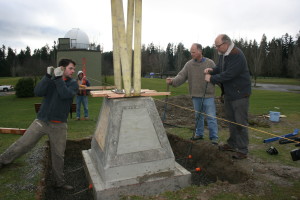


 was the keynote speaker at the recent annual banquet of the