Showing posts with label Battle Point Astronomical Association. Show all posts

April 28, 2017

Hunting the geocached solar system on Bainbridge Island

Most of us have experienced a scale model solar system. A new one with a different spin will open up May 1 on Bainbridge Island. To find the Sun and planets in this solar system, you’ll have to conduct a successful geocache hunt.

“Everybody who does it can collect the entire set of planets and custom stamps in a passport book, but the trick is, they have to go to each planet to do it,” said Erica Saint Clair, proprietor of Rosie Research, which creates fun science learning adventures for kids and families. Saint Clair also leads the BP Astro Kids education program of the Battle Point Astronomical Association (BPAA). It was through the latter that the idea for the geocache scaled solar system model came about.

Adventurers can explore a geocached solar system on Bainbridge
Island beginning May 1. Find the treasure chest at each planet and
get a stamp for your passport. Visit every planet
to win cool prizes! Photo: Greg Scheiderer.
About a year ago the BP Astro Kids made solar systems on a string, but it was a challenge to create an exercise that represented both the proper sizes of planets relative to each other, as well as the scale of the distances between them at those sizes. The BPAA children’s librarian suggested just making an island-wide solar system using geocaching. Saint Clair originally laughed at the idea—thinking that’ll be easy!—then rolled up her sleeves and got to work. Now it’s about to go live. The Sun is about five feet in diameter in this solar system.

“It fits really well on the island, and it gives a really good perspective for people about the size of our solar system,” Saint Clair said.

“You can walk downtown Winslow and go through our terrestrial planets, and then Jupiter and Saturn and the other guys are a little further away,” she added. “You definitely need a car for Pluto because it’s the other end of the island.”

Visit every planet on Bainbridge Island and get this cool
patch. Photo: Rosie Research.
The key piece of documentation for the hunt is the solar system passport. The passport includes information about the project and interesting facts about the Sun and each planet. Most importantly, it gives the coordinates of each of these objects. Go to Bainbridge Island, plug the coordinates into a GPS device—the map app on your smart phone will do, but there are also special geocaching apps—and the search is on! At each spot geocachers with a good eye will find a hidden treasure chest with a special stamp for their passport—that’s how you’ll prove you’ve been there. Some local businesses will be handing out the passports, and some are offering prizes like ice cream or pizza for those who collect certain stamps.

“It’s not only a geocache hunt, it’s also a fun afternoon activity with treats,” Saint Clair said.
Geocachers who visit every planet can bring their passport to one of the monthly BP Astro Kids events and receive a colorful completer’s patch as the reward for their dedicated pursuit of scientific knowledge.

Saint Clair said that a goal helps motivate many kids to finish a project like this; her own daughters are the user testers for many of her projects, and it works on them! She’s hoping that the challenge of the hunt will inspire interest in the project.

Challenge of scale modeling

There are a lot of big numbers in astronomy, and Saint Clair said that’s a challenge for this sort of endeavor.

Erica Saint Clair presents BPAstro Kids
programs for the Battle Point Astronomical
Association.
“It’s really difficult to scale a model, because either the sizes are so unfathomable or the distances are so unfathomable, and to bring one into focus inherently blurs the other,” she said. She hopes that using informative passport books will help convey more information that might not work at the scale of the model.

The Battle Point Astronomical Association will hold an Astronomy Day celebration at Battle Point Park on Bainbridge Island from 3 p.m. until 9 p.m. this Saturday, April 29. Saint Clair said kids and families can pick up their passports and take a solar system tour that day in preparation for the solar system geocache hunt going live on Monday.
If you’d like to support the educational efforts of Rosie Research, visit their Patreon Page and become a patron of science.

April 4, 2016

Edible optics and fun science for BPAstro Kids

Astronomy club members are sometimes heard lamenting the graying of the hobby; young kids today are too interested in their electronic gizmos to look up at the night sky. Erica Saint Clair and the Battle Point Astronomical Association (BPAA) have embarked on a new effort to hook the kids while they’re young. The association has recently started BPAstro Kids, a program for younger children that precedes its monthly planetarium shows in the John Rudolph Planetarium at its Edwin Ritchie Observatory on Bainbridge Island.

Erica Saint Clair presents BPAstro
Kids programs for the Battle Point
Astronomical Association.
Though education and the planetarium have been part of the BPAA’s mission since its formation in 1993, the program for kids came about recently as something of an accident. Saint Clair took her youngest daughter to story time at the local library, and met another mom there whose husband makes regular presentations at the association’s events. She was recruited to do a talk about Mars rovers.

“I have no background in astronomy—zero,” Saint Clair said. “I have a Ph.D. in physics, which apparently qualified me.”

She did the talk, which took a lot of time to prepare and bored her five-year-old terribly. Saint Clair also has a two-year-old, and decided that she would prefer to make presentations for younger children.

“My passion is for teaching kids science, and making it fun, and making them want to do it and beg me to do it,” Saint Clair said. “It helps to have a five-year-old who is really into and really excited about everything we do in science.”

Thus BPAstro Kids was born, presented by “Dr. Erica,” who figured if she was already creating science activities for her own daughters, she might as well share with others. The sessions feature short talks followed by hands-on activities. The kids have built edible optics, Valentine’s “love bots,” and marble particle accelerators. This Saturday they’ll make real, working telescopes they can take home. They started with one session before the monthly planetarium show, but so many people brought their kids they’re doing two now.

“I feel like we’re snowballing, and that’s fantastic,” Saint Clair said. She’s working on turning her presentations into a science-education business. She’s founded Rosie Research, with the aim of engaging kids in new types of science labs. They may eventually make tools such as telescope-making kits available for purchase. In the meantime Saint Clair goes about the business of inspiring youngsters.

“My goal is to get kids interested in all types of science, and I think space science is kind of the go-to for kids,” she said. “Every kid wants to go to the Moon, every kid wants to see what Mars is going to be like.”

Saint Clair is encouraged by the interest in BPAstro Kids and said she feels we are beginning to value “smart” again.

“I think we are as a culture shifting towards ‘science is cool and it’s sexy and it’s fun,’” she said.

Kids can build telescopes at BPAstro Kids at 5 p.m. and 6 p.m. this Saturday, April 9 at the Edwin Ritchie Observatory in Battle Point Park on Bainbridge Island. Suggested donation is $5 to help cover costs. A presentation about space telescopes will follow at 7:30. BPAstro Kids has received financial support from BPAA, the Awesome Foundation, and Rotary International of Bainbridge Island.

April 14, 2015

Battle Point sundial project nearing completion

Seattle Astronomy was excited to get a note over the weekend announcing that the Battle Point Sundial Project is nearing completion. The Battle Point Astronomical Association (BPAA) reports that its spectacular, 12-foot-tall equatorial bowstring sundial should be installed near its Edwin E. Ritchie Observatory in Battle Point Park on Bainbridge Island within the next few weeks, depending on the delivery schedule of the sundial’s fabricator.

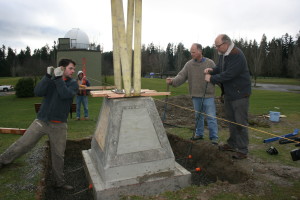
The foundation is prepared for the Battle Point Astronomical
Association equatorial bowstring sundial. From L-R: Dylan
 Sievertson (PHC Construction, built the foundation); Nels
Johansen (BPAA Vice Pres); David Browning (Sundial Engineer);
Bill Baran-Mickle (Sundial Artist/Designer). Once the
foundation was aligned and leveled, more concrete was
poured around it to lock it in place. The Edwin E. Ritchie
Observatory is in the background. Photo: Malcolm Saunders.
The BPAA has had this project on the drawing board for a long time. After slowly collecting funds over the years at their planetarium shows and other events, they reached a critical mass two years ago. Committed volunteers started to drive the project, and in late summer of 2013 they launched an Indiegogo campaign to raise $17,000 to bring their kitty up to the $30,000 they needed to build the sundial and install it in the park. The campaign drew some 75 donors, including Seattle Astronomy, and though it fell somewhat short of its goal, the attention the campaign attracted drew other outside funding, including a $1,000 grant from the North American Sundial Society, and BPAA amassed enough cash to move ahead with the project.

Their original goal was to have the sundial installed and dedicated by last spring, but they ran into some delays as sometimes happens with construction projects. They’re on track now with the foundation in place and ready for sundial delivery, and the sundial itself is fabricated and painted and ready to roll.

The sundial will be more than just a celestial timepiece. It will be a work of art and a conversation starter, and it will be a focal point for the BPAA’s facilities, which include the Ritchie Observatory, home of the 27.5-inch Ritchie Telescope and the John H. Rudolph Planetarium.

October 20, 2013

All systems go for Bainbridge sundial project

A sundial project that the Battle Point Astronomical Association (BPAA) has had on the drawing board for years will become reality by summer if all goes as planned. A fundraising effort anchored by an Indiegogo campaign has been a success.

“We’re only about $150 short of where we need to be, so on the strength of that we’re moving ahead,” said Frank Petrie, a BPAA member who is heading up the sundial effort. “It’s a done deal.”

BPAA members, with artist Bill Baran-Mickle at the center,
pose with a model of the proposed sundial. BPAA photo.
Interestingly, the Indiegogo campaign fell well short of its goal, raising just $6,610 of the $17,000 needed to meet the project budget of about $30,000. Petrie said, however, that the campaign helped raise the overall visibility of the sundial project.

“A lot of donations came in outside of Indiegogo,” he said. “Even though we fell well short of our Indiegogo goal, all of this other money coming in outside of Indiegogo was able to bring us to the point where we successfully funded the project.”

The North American Sundial Society chipped in with a grant of $1,000 and several other significant private donations also were made.

“It was really gratifying to see how people stepped up and really got enthusiastic about the project and supported it,” Petrie said.

He gave a big nod to University of Washington astronomy professor Woody Sullivan, known in some circles as “Mr. Sundial.” Sullivan appeared in the video supporting the sundial campaign and also connected BPAA with the Sundial Society.

Bainbridge Island sculptor and metalsmith Bill Baran-Mickle is finalizing the design for the equatorial bowstring sundial, which will stand 12 feet tall. Petrie said the next steps are some engineering for the foundation for the sundial, which will be erected in Battle Point Park near BPAA’s Edwin Ritchie Observatory, then building the foundation, fabricating the sundial, and installing it.

“We hope to complete all that process by late spring, so hopefully we can have a dedication in late spring or early summer,” Petrie said.

Petrie added that additional contributions would be welcome. There’s a long-term plan to build a plaza at the sundial site, but that if enough donations are made in the coming months they could speed up the time line on that. Contributions can be made by check or online at the BPAA website. Earmark any contributions for the sundial project.

Petrie admitted that the original goal was pretty ambitious.

“It was a little daunting, but I’ve been really gratified. The Bainbridge Island community is good that way. They get excited about stuff like this,” Petrie said, adding that it wasn’t just islanders. “The response has been pretty overwhelming from all over. That’s been really nice.”

We look forward to attending the dedication of the sundial next summer if all goes as planned.

September 15, 2013

Bainbridge sundial project in home stretch

The shadow is moving on the Battle Point Astronomical Association (BPAA) as it seeks to raise the funds needed to build a large equatorial bowstring sundial near its Edwin Ritchie Observatory in Battle Point Park on Bainbridge Island. With a week left in the association’s Indiegogo campaign, they’ve raised $4,535 toward the goal of $17,000 needed to fully fund the project.

BPAA members, with artist Bill Baran-Mickle at the center,
pose with a model of the proposed sundial. BPAA photo.
BPAA is actually a bit closer to the target than that. Frank Petrie, a BPAA member and part of the sundial committee, says they’ve raised more than $3,000 outside of Indiegogo since they launched the campaign about a month ago. Positive coverage of the effort has no doubt helped; in addition to our Seattle Astronomy article, the sundial project has received notice from the Bainbridge Island Review and Kitsap Sun. A contribution of $1,000 came in from the North American Sundial Society, which features a story about the BPAA effort on its website.

The budget for the sundial is $30,000. With previously received donations and contributions that have come in during the Indiegogo campaign, Petrie says they’re now within $10,000 of making the sundial a reality.

Even if they don’t reach the Indiegogo goal, they’ll receive funds pledged (less Indiegogo’s cut), and Petrie says they’ll bank that and take on other fundraising efforts until they have enough.

Why not resolve that worry and help them out today? Visit the campaign site, watch their video, read about the project and excellent perks for donors, and contribute to this worthy project. The sundial will be a significant piece of public art that will be a conversation starter, and it may well help spark some interest in astronomy.

August 24, 2013

Bainbridge astronomers seek funding for sundial

The Battle Point Astronomical Association (BPAA) has been working for many years on a plan to build a sundial next to its Edwin Ritchie Observatory in Battle Point Park on Bainbridge Island.

“It has been in the master plan for the organization almost since the get-go,” says Frank Petrie, a BPAA member since 1996 who is part of the sundial committee. The sundial would be built on a berm north of the association’s observatory and would be visible throughout much of the busy park.

BPAA members, with artist Bill Baran-Mickle at the center,
pose with a model of the proposed sundial. BPAA photo.
The project took a major leap toward reality with the launching of an Indiegogo crowdfunding campaign earlier this month. Petrie says the aim of the campaign is to raise the $17,000 they need to fully fund the sundial.

The budget for the spectacular, 12-foot-tall, bronze-clad steel equatorial bowstring sundial, designed by Bainbridge metalsmith Bill Baran-Mickle, is $30,000. BPAA has collected about $13,000 toward the project over the years from the donation jar at their monthly planetarium shows and community events, a pledge from its board, and recent grants from the Bainbridge Island Metro Park and Recreation District and the Bainbridge Community Foundation. The latter, Petrie says, indicated to BPAA that there was widespread community interest in the sundial.

“There’s interest in this project coming from the arts community as well,” he says, because of the renown of Baran-Mickle and the desire for more public art at Battle Point.

Woody Sullivan, a University of Washington astronomy professor also known as “Mr. Sundial,” makes a pitch for the project in the BPAA’s video on Indiegogo.

“Sundials connect you with the cosmos,” Sullivan says in the video. “They connect you with a more natural kind of time than a digital, flashing watch. They tend to slow you down, also, which is something I think we need in our 21st Century iPhone existence.”

Petrie says the sundial is a first step in BPAA’s ambitious vision for its astronomy programs at Battle Point Park.

“Our hope is to build an astronomy-related complex around our observatory in Battle Point Park,” he explains. “We have a number of features that we’d like to incorporate, and the sundial is one of those features.”

Another is an adjacent building for BPAA’s planetarium. Monthly planetarium shows are presently wedged into the Helix House, which also houses the observatory. But the space is small and cramped, and typically far more interested people show up than can be accommodated, forcing many to wait for a second show, or miss out.

“It’s been very, very popular, and that tells us that our long-term plan to expand is a good one,” Petrie says.

The popularity is well-deserved; BPAA puts on a good show. Seattle Astronomy recommends them highly.

Petrie calls the BPAA and its facilities “a little jewel” and says he loves the organization’s commitment to its mission.

“It’s dedicated to public outreach and getting folks interested in science,” he says. “We like to share the excitement that we have about science in general and astronomy in particular, and hope that we can reach as many folks as possible and get them excited as well.”

You can help share the excitement by contributing to BPAA’s Indiegogo campaign for the sundial.

June 2, 2012

Weather angst and the Venus transit

Venus will transit across the face of the Sun Tuesday afternoon. This rare celestial event won’t happen again until the year 2117, and Northwest astronomy hobbyists, for good reason a highly pessimistic bunch when it comes to matters of cloud cover, have been warily watching the long-range forecasts since June 5 started to show up on the weather radar.

It is not looking pretty.

The 2004 Venus transit was captured from
Germany in this image by Jan Herold. Creative
Commons, GNU free documentation license.
As of this writing, Saturday, June 2 at 4 p.m., the Seattle forecast for Tuesday afternoon was for clouds and a 30 percent chance of rain. The prediction for much of the Northwest looks similar. Our best bet as of the moment looks like Goldendale, with a forecast of merely partly cloudy and just a 10 percent chance of rain. (Really, we don’t care so much if it rains as long as it’s not cloudy!) Yesterday Moses Lake and Wenatchee looked promising, but those forecasts have flipped. We’d also been eyeballing the “rain shadow” of Sequim, but even that Olympic Peninsula town now has a wet forecast for Tuesday. The closest “sunny” forecast I am able to find is for Red Bluff, California. Do you roll the dice on an 11- or 12-hour drive, or hope for the best somewhere a little closer?

Many of us will likely be watching the weather forecasts up until Monday evening or Tuesday morning, making some last-minute decisions about where our chances look best for transit viewing, and then high-tailing it to those spots.

Of course, it’s possible, maybe even likely, that we’ll out-think ourselves on this decision. The lore of celestial event chasing is full of accounts of people who have made extreme travel efforts to get to places certain to be clear, only to find those locations socked in while the sky above their own backyards was crystal clear.

Why are we making such a big deal of this? Due to the peculiar geometry of the orbits of Earth and Venus around the Sun, we can only see a Venus transit occasionally. They come in pairs separated by eight years, and either 105.5 or 121.5 years go by before the next pair comes along. Tuesday’s transit is the second of a close pair. Unfortunately, the 2004 event wasn’t visible from the West Coast, and only the end of the transit was visible from the Eastern U.S. as the Sun rose that day. Europe, Asia, and Africa had the best views last time. So this is your last chance unless you make it to December of 2117.

There will be plenty of opportunities to enjoy the 2012 transit from Seattle if the weather cooperates. Events actually begin the evening before, Monday, June 4, at the University of Washington. Astronomy Professors Woody Sullivan and Victoria Meadows will give lectures about the significance and history of Venus transits. The talks begin at 7 p.m. in room 120 of Kane Hall on the UW’s Seattle campus. It’s free, but registration is required.

The UW will have several locations for viewing the transit when it begins at about 3 p.m. June 5. Viewing will also take place at the Pacific Science Center, Solstice Park in West Seattle hosted by Alice’s Astro Info, Battle Point Park on Bainbridge Island hosted by the Battle Point Astronomical Association, and others listed here by the Seattle Science Festival. Many of these sites will at least have online feeds, so participants can watch the transit as viewed from less weather-challenged areas. Other astronomy clubs are likely to be holding formal or informal transit viewings.

Seattle Astronomy will likely be at the Solstice Park event, unless we’re beating it to Goldendale.
Remember, don’t look at the Sun without proper protection. You’ll zap your eyeballs. Standard sunglasses are not good enough. This NASA website has some good pointers about transit viewing, eye protection, and pinhole projectors, as does transitofvenus.org.

Let’s hope we don’t miss our chance to see an astronomical rarity!

December 5, 2011

Local editor recognized for work on astro newsletter

Vicki Saunders, editor of BPAA Quarterly, the newsletter for the Battle Point Astronomical Association of Bainbridge Island, recently received fourth place recognition from the Astronomical League in the competition for the Mabel Sterns Newsletter Editor Awards. It’s the third time in the 14-year history of the awards, named for the AL’s first newsletter editor, that BPAA has placed. Saunders received honorable mention in 2006, and Bill and Anna Edmonds took fifth place in 2002.

Mabel Sterns, above, was the first editor of
the Astronomical League newsletter, and now
the league's award for newsletter excellence bears
 her name. Vicki Saunders of the Battle Point
Astronomical Association on Bainbridge Island took
fourth place in this year's awards.
Photo: Astronomical League.
Northwest astronomy clubs have not been all that well represented in the Sterns Awards. Rose City Astronomers from Portland took first place back in 2007 with the Rosette Gazette, edited by Larry Deal. Seattle Astronomical Society‘s Webfooted Astronomer, edited by Laurie Maloney, took a third in 2001, and Kathleen Higgins took second in 2002 for the Boise Astronomical Society newsletter.

The awards have a fairly rigorous nomination process, and Saunders noted that the recognition came despite the fact that she ignored one of the league’s strong suggestions, and that was to include the AL logo, preferably on the first page! The judges, former newsletter editors as well as editors of The Reflector, the Astronomical League magazine, apparently ignored that omission in their deliberations and recognized Saunders’ outstanding publication.

As a former editor of The Webfooted Astronomer, I recognize the challenge of putting out a good product month after month. It’s tough to find or create enough content. BPAA president Stephen Ruhl’s nominating letter was quoted in the AL Reflector in praise of Saunders’ work: “Vicki’s efforts create a newsletter that meeets the needs of the association and that draws the community into astronomy and the BPAA. It is the glue that holds our local astronomical community together.” The winter 2011/12 issue is a good one, with seven feature articles created by club members.

Submissions for the 2012 Mabel Sterns Awards are due by March 31. Complete information about how to apply is on the AL website.

Congratulations to Vicki Saunders, and hats off to all of the astronomy club newsletter editors out there who keep their members informed and engaged.

August 28, 2011

BPAA puts on a good show

The Battle Point Astronomical Association has a great facility on Bainbridge Island and a dedicated and knowledgeable corps of enthusiastic volunteers. The combination adds up to a satisfying visit for stargazers both experienced and new to the hobby. I attended the association’s planetarium show and star party Saturday evening, Aug. 27, and had a marvelous time.

Helix House is home of the Battle Point Astronomical
Association, the Edwin E. Ritchie Telescope, and John H.
Rudolph Planetarium on Bainbridge Island, Washington.
Photo: Greg Scheiderer.
It all happens in Helix House, an old military radio facility in the middle of Battle Point Park on Bainbridge. The House is home to the Edwin E. Ritchie telescope and observatory, the John H. Rudolph planetarium, and association offices, a meeting room, workroom, and library.

Saturday BPAA president Steve Ruhl put on an engaging presentation about killer asteroids. Using the planetarium’s computer system, Ruhl illustrated the rapid increase in the numbers of known asteroids in our solar system, and the crazy orbits some of them take, including a great many whose orbits often cross that of Earth. He noted that a really big asteroid collision with Earth, like the one that wiped out the dinosaurs 65 million years ago, is about a 1-in-65,000,000 year event.

Oh-oh. As Ruhl understated, that would be a bad day. He showed a PG-13 video imagination of such an impact, which would envelop the surface of our planet in flame within a day. That would be most unpleasant. The hope is that, as methods for detecting and tracking asteroids get more sophisticated, we will be able to spot “the big one” with enough advance notice to be able to do something to prevent it.

A couple dozen people attended the presentation. Ruhl used the planetarium in his talk, though noted that it was a little inadequate for the topic. It’s software includes data on about 500 asteroids, a tiny fraction of the more than 30 million such objects now known.

After the planetarium show many visitors climbed the three-story spiral staircase to get a peek through the club’s showcase, the Ritchie telescope, a 27-inch Newtonian reflector club founders built themselves. On this night, the great instrument was pointed at M 13, the great globular cluster in Hercules, a favorite object at star parties. It was an eye-popping view on a perfect night. The weather was marvelously clear, New Moon was just hours away, and the site has good horizons and a fair amount of protection from Seattle’s city lights.

At least half a dozen BPAA members had their telescopes set up for viewing as well, and stargazers of all ages lined up for looks at what was up in the night sky.

For those interested in learning a bit about astronomy, you can’t lose with a visit to Battle Point. Congratulations to the club for running a marvelous outreach effort. Watch Seattle Astronomy for information on their monthly star parties.