Showing posts with label people. Show all posts

March 12, 2020

Goldendale Sky Village gives amateur astronomers dedicated observing site

Amateur astronomers in the Seattle area have been dreaming of a clear, dark place from which to observe the heavens since the clouds rolled in and light pollution obliterated much of the night sky. Those dreams are coming true at the Goldendale Sky Village just east of that south central Washington town.

It's dark at Goldendale Sky Village! This image
made at the site was created by Mark Vinup.
The Goldendale Sky Village (GSV) is owned by a limited liability company (LLC) of the same name, made up of members with interest in astronomy. The effort to establish the GSV is the end result of a search several decades in the making.

Most recently, the Seattle Astronomical Society (SAS) took a run at establishing a dark-sky observing site beginning in about 2005. Three years later, the project was tabled because the society couldn’t reconcile two desired criteria for the site: clear, dark skies and convenient proximity to Seattle. (I wrote about the end of the project for the April 2008 issue of the SAS newsletter, The Webfooted Astronomer.)

In 2016 Stephanie Anderson, a co-owner of Seattle’s Cloud Break Optics who was president of the SAS at the time, wanted to re-start the initiative and recruited SAS member Christopher Smythies, who is now the general manager of GSV, to head up the search.

Searching for the spot

“For two years I went out east of the mountains and familiarized myself with the land,” Smythies said. His focus was on two areas: Cle Elum and Goldendale. He found Cle Elum to be prohibitively expensive, and most parcels of land available for sale there were intended for housing and carried restrictions.

“Goldendale had a lot of attractive things about it,” Smythies said. “It was darker, the land was much cheaper, the rules were much looser, but it was further away.”

Smythies figures he must have looked at more than 100 properties over the course of a couple of years. By the time of the annual SAS Spring Star Party in May 2018 at Brooks Memorial State Park near Goldendale, he had a list of five of them for attendees to check out. The last of those that they visited is the one that is now Goldendale Sky Village.

“I immediately knew that was going to be it,” he said. “It was very remote, it was relatively flat, there were low horizons. It was pretty land; it wasn’t scrub land or pasture land, it was very attractive land with nice vegetation on it. And it was relatively cheap.”

“I thought it was perfect,” Smythies added. Unexpected bonuses include a line of sight to a communication tower that gives the site Internet access, and a great view of Mt. Hood to the west. There is federal land and open prairie nearby that will likely remain unoccupied, so future light intrusion isn’t a big concern.

LLC created for site

By this time the Seattle Astronomical Society had cooled to the idea of owning and operating a dark-sky site. Current president John McLaren said cost was a big concern. SAS would have had to do a major, multi-year fundraising effort or raise dues drastically to cover costs. Neither seemed likely to fly given the varying visions SAS members have for such a site. They considered trying to build a coalition with other regional astronomy clubs.

“That looked like it would be a legal headache,” McLaren noted. Running the site also would have created administrative tasks, including IRS reporting, that would have placed a burden on the club. The SAS board opted out.

“At that point, I decided to go another route to form a private group of people, an LLC, and then make it available to the SAS later on,” Smythies said. In June he put out a call for possible investors in the site.

“Within six weeks, two of which I was on vacation, we had 21 people saying ‘I’m in,’” he said. Smythies believes that a turning point for the project was when Anderson and Cloud Break Optics co-owner Matt Dahl signed on.

“She and Matt have such a good reputation for being kind of the hub of the astronomy community because of Cloud Break Optics, that once they said they wanted to be a part of it it was like a stamp of approval and everyone else piled on,” he said.

Astronomy can be hard work! Goldendale Sky Village
members clear rocks from the future telescope field, the
National Dark Sky Portal. Photo: Christopher Smythies.
Original members paid $1,000 per share in the new LLC. That entitled them to the use of their own 2,500 square-foot parcel within the village. They sold more than 100 shares and by the end of July had the cash to buy the land. The purchase became final in September 2018.

Since then they’ve made improvements to the road into the property, created parking space, and moved “a billion” rocks and boulders to create a smooth place for the village’s central telescope field, known as “The National Dark-Sky Portal.” They’re planning for improvements that include a big tent, the Red Light Lounge, for sharing refreshments and for shelter from the elements. Work this summer may include bringing electricity to the site as well.

It takes a village

Smythies says the village aspect of the GSV is vitally important.

“I wanted to put together something where people have lots, sure, but then there’s common areas right in the middle where they put their telescopes out and they observe together,” he said. This differs from some large astronomy communities where people might build a home on a two-acre plot. “Goldenndale sky village is all close together to promote the community atmosphere and the learning.”

While the GSV is a private company they intend to invite guests often. They hope to be ready by this year to host the SAS and its spring and fall star parties, and would like to build a similar relationship with the Rose City Astronomers in Portland, which is actually closer to the site. Smythies dreams of an astrophotography school and other educational efforts at the village.

The SAS hasn’t given up on creating observing sites. McLaren, who is a member of GSV, said SAS members also crave a dedicated site within 30 minutes of the city and one perhaps in the Cle Elum or Ellensburg areas, that might offer better observing conditions and still be relatively convenient. He hopes the Goldendale Sky Village model can be a good template for creating more observing sites.

“That would be awesome if it happened,” McLaren said, “and if some day astronomy clubs were able to negotiate access to all three locations that would be amazing.”

Smythies says there is room for perhaps 60 to 70 members at Goldendale Sky Village. The current price to join is $2,500 per share with a minimum of four shares. You can check out the site at an open house on March 21. Contact Smythies if you’re interested.

December 8, 2016

Preserving the stories of Viking

Rachel Tillman has a scrapbook that is out of this world. What started out as a young girl’s effort to save a cool piece of space history has morphed into a project to preserve the artifacts of the iconic Viking program and the stories of the people who made it happen.

Tillman is the founder, executive director, and chief curator of the Viking Mars Missions Education and Preservation Project, a Portland-based nonprofit that has a huge collection of photos, documents and artifacts from the Viking missions and aims to collect oral histories of some 10,000 people who had a hand in the project—the “Vikings,” as Tillman calls them.

Little kid heaven

Her interest in the mission started early.

“My father worked on the Viking mission,” she said. He is James E. Tillman, a professor emeritus of atmospheric sciences at the University of Washington who was a member of the Viking meteorology team.

“He is an explorer; scientists often are explorers,” Tillman said of her father. “He was so engrossed in his work that lived and breathed it. He brought it home at night.”
What he often brought home was the latest problem or design or a new photo from the lander, and he would ask the kids what they thought about it. Rachel ate it up.

One of the more famous photos in planetary exploration history:
the first sent from Viking 1 shortly after it landed on Mars
July 20, 1976. The original is part of the VMMEPP collection.
Photo: NASA/JPL.
“I was interested from the get-go,” she said. Often she would go to her father’s office after school and soak up all of the conversations he and other scientists were having about technical matters. She’d go look it up and figure out the language, and would often make drawings about what she was learning. She made a few trips with her father to the Jet Propulsion Lab in California, and then got to go to Florida for the launches of the Viking spacecraft in 1975.

“We were down there at Cape Canaveral for the launch with Carl Sagan and Gerry Soffen and my dad and the guys from KSC,” she said. “I saw the rocket fly off.”

That’s quite a crowd for a little kid to hang out with. Rachel recalls Sagan as intense and funny, but said Soffen, the chief scientist on the Viking mission, was her hero.

“He was thoughtful, funny, very smart, absolutely wanted to know whatever it was out there to know,” she said. “He was also a magician. I’m a kid, that’s really cool!”

“The makeup of the people of the mission was amazing,” she added: Hard working, dedicated, sacrificing, funny, intelligent, grumpy, passionate—all of those things that a kid really picks up on.”
“I couldn’t have dreamed a better life than I live,” Rachel said.

They were going to melt it down

Viking was in Rachel’s DNA, but her work as a preservationist started almost as an accident.
NASA built three flight-ready Viking landers, but the first two worked and so the third—VL3—was not needed. Several groups and companies fiddled with plans to turn it into a rover, but ultimately nobody had any funding to do anything, so the lander was set aside. Then around 1979 James Tillman was looking for some used filing cabinets and found some interesting items on the NASA surplus list: his own Viking meteorology instrument, and VL3.

They didn’t scrap Viking Lander 3! The lander, owned
by Rachel Tillman, is on exhibit at the Museum of Flight.
 Photo: Greg Scheiderer.
“They were scrapping it,” Rachel said. “They were going to melt it down.”

She immediately said that they had to get it and save it. Her father thought it was a ridiculous idea, but she convinced him to do it anyway because she had a ready purpose for the lander.

“We’re going to put it in my school,” she told him, “and we’re going to teach kids about robotics and about Mars and about science and engineering.”
Rachel now owns the Viking lander VL3, and it actually was at her school for a while. It also was on display for some time in the electrical engineering department at the UW. For the last ten years it has been on loan to the Museum of Flight, where it is a part of the permanent exhibit Space: Exploring the New Frontier.

“That’s how my preserving began, was with the Viking Lander,” Rachel said. Though it started with a great piece of historic hardware, Rachel is now drawn to the human side.

It’s about the people

“My role as a kid who grew up with the mission is to honor the people who did it,” she said. “Everybody. Not just the rock stars.”

The author in front of information boards the Viking Mars
Missions Education and Preservation Project uses at outreach
events. The box my arm is resting on contains James Tillman’s
Mars meteorology instrument. Photo: Rachel Tillman.
“Every Viking represents a child today that may want to do something like what they did,” Rachel added. “They don’t have to be the mission director, they don’t have to be the principal investigator of a science instrument, they don’t even have to be the lead engineer.”
So many other people had important functions from keeping travel schedules to crunching numbers to designing small but important components of the landers.

“All of these people are so critically important to the mission, and 95 percent of them were forgotten,” Rachel said. “That’s my job: preserve the history and the individuals; not just the timeline events, but the people who did them. That’s what this is all about.”

The Viking Mars Missions Education and Preservation Project was founded in 2008, but only really started doing any outreach in the last year. It’s been mostly underground work as Rachel met and interviewed as many of the Vikings as possible. She thought it was important to do some public events this year, the 40th anniversary of the Vikings’ landings on Mars. They held an open event in Denver—the landers were built there by Martin Marietta, which is now Lockheed Martin. NASA also held some events at Langley and at JPL, and the project held three “Science Pub” talks last month through the Oregon Museum of Science and Industry.

The future of VMMEPP

To date the project has run mostly through donations from James and Rachel Tillman, some of the Vikings, and a few others, but in the next year or so they will be doing some more serious fundraising.

“Our plan is to create a trust fund around all of the artifacts of Viking so they can’t be given away or sold,” Rachel said. “As we get new donations they will stay in this trust.”

She said the fund will help with management of the artifacts as well as preservation. Then in the next year or two they plan to issue a request for proposals from institutions and organizations that would like to host the Viking artifacts.

“They’ll have to meet the requirements that we set for care of the artifacts and for creating access to the artifacts for the public, because that’s critically important,” Rachel said.

In the meantime, the project has established an online museum, where you can go page through raw documents from the Viking missions. The project website is a treasure trove of photos and facts and stories about the Viking missions.

Rachel plans an outreach event at the Hillsdale Library in Portland for December 20, but then will probably be mostly invisible for a little while.

“Doing the oral history interviews, creating access, and protecting the artifacts, those our our three really big pushes.”

It’s a fascinating and worthy cause. If you would like to help with the preservation effort, you can donate to the project online through Facebook (through December 13) or Amazon Smile, or simply send a check to:

Viking Mars Missions Education and Preservation Project
5331 SW Macadam #258-504
Portland, OR 97239

December 1, 2016

Reaching kids with "The Big Eclipse"

Those who are convinced that the stars do not affect our lives might wish to consider the story of Elaine Cuyler. Up until recently, Cuyler was minding her own business and working as marketing manager for Eola Hills Wine Cellars just west of Salem, Oregon.

“I never dreamed I’d be working on a kids’ book, let along one on eclipses,” Cuyler said. But that’s exactly what happened. When she learned that the total solar eclipse on August 21, 2017 will cross right over the vineyard, she decided an eclipse-viewing event would be a great way to attract visitors to the winery. As she researched the eclipse, it occurred to Cuyler that kids would really enjoy viewing a total solar eclipse.

“There was really no-one else talking to kids about the eclipse at the time,” she said. Out of that realization Orbit Oregon was born, and Cuyler became its chief eclipse officer. She teamed up with Nancy Coffelt, a well-known author and illustrator from Oregon, to create the book The Big Eclipse (Orbit Oregon, 2016).

“Although I had this concept in mind, it’s really Nancy’s drawings that brought it to life,” Cuyler noted. They also created a kids’ activity book; you can read our review of both, posted last month. Cuyler said there are a couple of purposes behind The Big Eclipse.

“First, I thought it was a great opportunity for kids to learn about astronomy and science and see something really cool,” she said. Secondly, she noted that adults often don’t know what’s going on, either. Her mother was a teacher in Portland during the 1979 total solar eclipse; they were told not to look up, and broadcasters ran public service announcements warning of the dangers of looking at the Sun. While it’s true that proper eye protection is needed to look at the partial phase of a solar eclipse, the warnings amounted to a missed opportunity.

“The concept of a solar eclipse is something that a lot of people aren’t familiar with,” Cuyler said. “That’s why there’s a lot of information [in the book] for parents, too, because they need to learn about it just as much as the kids.”

Providing inspiration

Ultimately, though, it all comes back to the kids.

“We felt that as soon as you can get kids interested in science the better,” Cuyler explained. “Maybe they’re not going to want to sit and listen to a lecture, but they do like crafts, they all know about the Sun, the Moon, and the stars. To get kids thinking about the world around them and how it functions, that’s really the start of getting them to think about why the world works the way it does, and you use science to explain that.”

As Cuyler and Coffelt worked on The Big Eclipse their research included talks with astronomers and folks from NASA who looked at their material. They also spoke with many people who had seen total solar eclipses, including one couple who had viewed 15 of them.

Seattle Astronomy writer Greg Scheiderer, Orbit Oregon’s Elaine
Cuyler, and The Big Eclipse. We thought it was fun to get a
selfie in front of a sign that reads “Choose your own adventure.”
“Their feedback was so great because they shared photos with us and video footage, they told us about the different things that happen,” Cuyler said. “Talking with people who’d actually been through these was invaluable.”

They’ve already test-driven the book in school classrooms, and the kids seem to enjoy it, especially the part where they get to create and make a drawing of their own eclipse myths, just as ancient civilizations tried to explain this celestial phenomenon. Cuyler said the kids are creative and funny with their stories. Her own eclipse myth is a little more figurative.

“It would probably be the book completely eclipsing everything else in my life!” she laughed.

It’s a lot of work getting a book out there. The Big Eclipse is available on the Orbit Oregon website (which also features eclipse glasses and viewers) and Amazon.com, and it is being carried by a growing number of retailers. Cuyler is busy trying to get it into libraries, museums, schools, and summer reading programs, too.

What’s next?

As for the future of Orbit Oregon, Cuyler said The Big Eclipse is really all about the 2017 total solar eclipse, so the book sort of expires after next August 21. But she and Coffelt are considering other books, including volumes about solar eclipses in general, astronomy, and other science topics.

“We had so much fun doing this and we met so many great people that we may extend that,” Cuyler said. “Right now, we’re just focused on the eclipse.”

And on the kids. Cuyler hopes The Big Eclipse gets kids, especially girls, interested in science. When you mix in art and literature, you can grab their interest early.

“If you’re looking at science from an art perspective and crafts activities you can really start young,” Cuyler said. “It appeals to kids, and they’re learning while they’re enjoying the little story that they’re reading.”

Out of that story, and out of seeing a total solar eclipse, can come inspiration. They’ve heard many tales of science teachers who started on their career path when they saw an eclipse as a child.

“That’s what we’re going after, those young kids that might be inspired,” Cuyler said. “That’s really our mission, is to get kids to understand what they’re seeing, learn from it, and then be awed by this amazing spectacle.”

“Hopefully a new generation of science teachers will come out of it.”

Resources:
Purchases made through links on Seattle Astronomy support our efforts to bring you interesting space and astronomy stories, and we thank you.

April 4, 2016

Edible optics and fun science for BPAstro Kids

Astronomy club members are sometimes heard lamenting the graying of the hobby; young kids today are too interested in their electronic gizmos to look up at the night sky. Erica Saint Clair and the Battle Point Astronomical Association (BPAA) have embarked on a new effort to hook the kids while they’re young. The association has recently started BPAstro Kids, a program for younger children that precedes its monthly planetarium shows in the John Rudolph Planetarium at its Edwin Ritchie Observatory on Bainbridge Island.

Erica Saint Clair presents BPAstro
Kids programs for the Battle Point
Astronomical Association.
Though education and the planetarium have been part of the BPAA’s mission since its formation in 1993, the program for kids came about recently as something of an accident. Saint Clair took her youngest daughter to story time at the local library, and met another mom there whose husband makes regular presentations at the association’s events. She was recruited to do a talk about Mars rovers.

“I have no background in astronomy—zero,” Saint Clair said. “I have a Ph.D. in physics, which apparently qualified me.”

She did the talk, which took a lot of time to prepare and bored her five-year-old terribly. Saint Clair also has a two-year-old, and decided that she would prefer to make presentations for younger children.

“My passion is for teaching kids science, and making it fun, and making them want to do it and beg me to do it,” Saint Clair said. “It helps to have a five-year-old who is really into and really excited about everything we do in science.”

Thus BPAstro Kids was born, presented by “Dr. Erica,” who figured if she was already creating science activities for her own daughters, she might as well share with others. The sessions feature short talks followed by hands-on activities. The kids have built edible optics, Valentine’s “love bots,” and marble particle accelerators. This Saturday they’ll make real, working telescopes they can take home. They started with one session before the monthly planetarium show, but so many people brought their kids they’re doing two now.

“I feel like we’re snowballing, and that’s fantastic,” Saint Clair said. She’s working on turning her presentations into a science-education business. She’s founded Rosie Research, with the aim of engaging kids in new types of science labs. They may eventually make tools such as telescope-making kits available for purchase. In the meantime Saint Clair goes about the business of inspiring youngsters.

“My goal is to get kids interested in all types of science, and I think space science is kind of the go-to for kids,” she said. “Every kid wants to go to the Moon, every kid wants to see what Mars is going to be like.”

Saint Clair is encouraged by the interest in BPAstro Kids and said she feels we are beginning to value “smart” again.

“I think we are as a culture shifting towards ‘science is cool and it’s sexy and it’s fun,’” she said.

Kids can build telescopes at BPAstro Kids at 5 p.m. and 6 p.m. this Saturday, April 9 at the Edwin Ritchie Observatory in Battle Point Park on Bainbridge Island. Suggested donation is $5 to help cover costs. A presentation about space telescopes will follow at 7:30. BPAstro Kids has received financial support from BPAA, the Awesome Foundation, and Rotary International of Bainbridge Island.

February 15, 2016

Mixing science, art, and religion with Adrian Wyard

These days many folks would have the sciences go it alone. Education advocates repeat their mantra of STEM, STEM, STEMMMM while schooling in the arts is reduced or eliminated. Some scientists decry the so-called magic of religion. People of faith shun science because God is the answer. Adrian Wyard—software engineer, artist, astronomy buff, and Christian—believes science, art, and faith get along just fine.
Adrian Wyard
“As a child I always had those three elements in my life,” Wyard said in an interview earlier this month. “I grew up going to church back in England, I had a strong science and engineering interest, which sent me on a straight line into computer science, computer software design. That was my first career.”

Wyard fesses up to a certain level of single mindedness about computers in his youth.

“I had very little time for anything else,” he said, though he had some interest in art in high school, and that crept into his work.

“There was always a design element,” he said. “I was never that good at coding but I loved the big picture, I loved solving problems for real people, so I ended up focusing on designing user interfaces.”

He was the program manager for Word 1.0 at Microsoft.

“I was lucky enough to be there when all the good stuff happened at the beginning,” Wyard said. “That took a lot of my time,” he added in something of an understatement.

Changing course

After leaving Microsoft Wyard decided to reboot and attended Seattle Pacific University.

“I went to SPU to essentially do exactly the opposite of what I did the first time. So I took liberal arts, I took theater, I took English, I took sociology,” he said. “I just got totally enamored by these connections between different disciplines.”

Wyard wanted to learn more about those connections. The research was out there, but it was hard to find. He started the Counterbalance Foundation in 1998 as essentially an online library exploring the intersections of science and faith. The site now has in the neighborhood of 300,000 links and 200 hours of video. The site helps readers of multidisciplinary texts find resources to understand the particular disciplines with which they may be less familiar, and facilitates discussion and education.
“The idea of using interactive technologies to teach, to help people understand multidisciplinary subjects, just struck me as an obvious move,” Wyard said. In a way, he sees counterbalance as penance for his lack of multidisciplinarianism as a youth.

“The one subject I disliked the most was history, because as far as I was concerned everything happens starting with Turing in 1950 or thereabouts, and that’s it, and I did not want to be distracted from my main interest,” in computers, he said. “Counterbalance is basically me coming to realize the error of my ways.”

He also overcame his dislike of history, eventually going to Oxford to earn a master’s degree in the history of science, studying under John Hedley Brooke. While at Oxford Wyard specialized in the study of the tension between creation and evolution. His adult education gives him a better foundation from which to approach these knotty questions.

A search for the truth

Many people like to depict science and faith as warring factions, but Wyard sees both as having the same goal of seeking the truth.

“There is no religious person, as crazy as they may appear to other religious people, or atheists or scientists, who does not in their heart of hearts want to find what’s true and would be horrified to think that they were being misled. That will forever bind the religious inclination and the scientific inclination,” Wyard said. “On balance, what you find is just a compulsion to find out the way the world works, and almost always be in awe of that. There’s so much common ground, it’s hard to imagine it ever conflicts.”

Yet it almost has to at times. The tension between science and religion is a complicated one, Wyard said.

“If you want to talk about all the sciences and all of the religions, you can easily find examples among that huge landscape, of overt conflict, where one says this is the case and the other says the opposite,” he said.

Conversation at Taproot

Wyard will be giving a public presentation to discuss these ideas at 7:30 p.m. Tuesday, Feb. 16 at Taproot Theatre in Greenwood. The theatre is running Lauren Gunderson’s play, Silent Sky, about the Harvard astronomer Henrietta Leavitt. The drama tackles some of these same questions, and Wyard said he’s been thinking about delving a little into postmodernism for the conversation.

“Sometimes that can be a rabbit trail that you really don’t want to go down,” he said of postmodernism. “For some people it’s a keyword for a lot of troubling things.”

But Wyard said that the modernist concept of knowledge, which was very much in play during the time in which the play is set in the early 20th century, held that knowledge accumulates, you reach a conclusion, and then you have the answers. Religion, he noted, sometimes operates in much the same way.

“At least what postmodernism has done is show that in the sciences, that does not work,” he said. “There are precious few lines of scientific inquiry that don’t require you to also understand the perspective” of which questions are asked and the context in which any experiment is being conducted.

Postmodernism, Wyard said, “recognizes that science exists in a socioeconomic political framework, and there is nothing that happens that doesn’t have some connection through to economics or politics or even just social mores and preferences.”

Learning more

Wyard suggests a couple of books that may be of interest to people wishing to delve into this line of inquiry. One is The Language of God: A Scientist Presents Evidence for Belief (Free Press, 2007) by Francis Collins, who was lead of human genome project and is chair of the National Institutes of Health.

“That is a nice introduction because he takes us on the journey throughout his own story, which starts off as an athiest” though now Wyard said Collins identifies as evangelical. “He goes all the way through without losing any speck of his scientific interest and aptitude.”

The other book is Incomplete Nature: How Mind Emerged from Matter (W.W. Norton & Company, 2013) by Terrance Deacon, an anthropologist and neuroscientist at Berkeley. Wyard said it’s a fascinating book, though a bit of a heavy lift at more than 600 pages. He is working with Deacon and his research team to try to bring it to a more accessible level. There are a couple of lectures about the book in Counterbalance’s Bridging the Gaps section.

The Planets Live

Wyard started doing art again about five years ago. He is getting into greater touch with his artistic side, collaborating on a multimedia presentation of Gustav Holst’s composition The Planets. The work, which Wyard describes as a live, choreographed video accompaniment of the piece, was first performed in 2014 at the Highline Performing Arts Center as a project with the Northwest Symphony Orchestra. It hit all the right notes with Wyard, “combining my knowledge of computers, computer technology, space, and also the photography side came in too,” he said.

While The Planets Live stands on its own as art—see the trailer below—Wyard is also excited about it as a “killer educational tool.”

The Planets suite is a very accessible piece of music,” he said, noting that even kids who came in thinking that classical music is boring dug it at the premiere.

“They loved it because not only were the visuals interesting and stimulating, but it allowed them to access the music,” Wyard said. “It was a positive introduction to classical music, plus an introduction to astronomy.”

They did several other performances of the work in Sioux Falls last year with the South Dakota Symphony Orchestra, one of which was recorded and later aired by PBS. Several other performances are on the schedule for this year Lakeland, Fla. and Ann Arbor, Mich., and Wyard said they hope to bring The Planets Live back to the Seattle area again sometime soon, though this has not yet been set.
Adrian Wyard is an interesting person taking on some big questions. We expect you’ll hear more from him on Seattle Astronomy.


February 14, 2016

Senators and astronomy

We’re not in the habit of running obituaries on Seattle Astronomy—this, in fact, is our first one—but the recent passing of former state Sen. Harriet Spanel at age 77 merits mention here for a couple of reasons.

Former state Sen. Harriet Spanel passed
away Feb. 2, 2016 in Bellingham.
Washington State Senate photo.
The first is personal. Your correspondent served on the staff of the Washington State Senate during the 1990s, overlapping with Spanel’s first seven years as a member of that body. I found her to be a kind person and a pleasure to work with.

The second reason is more relevant to our usual subject matter. Spanel’s family has suggested a number of causes to which people could make contributions in memory of the late senator. One of them is the Dr. Leslie E. Spanel Memorial Planetarium Endowment at Western Washington University.

Les and Harriet Spanel met at Iowa State University when she was earning her degree in mathematics and he was completing a Ph.D. in physics. They married in 1961, moved to Bellevue in 1964 and to Bellingham in 1968 when Les began his teaching career at Western, where he was a member and sometime chair of the Physics Department and also was director for the planetarium. Les Spanel passed away in 2002. The planetarium, which was built in 1959, was named for him after Harriet made contributions in support of some major equipment upgrades in 2013. The planetarium is available for school groups, private shows, and also offers public presentations several times each month.

Harriet Spanel served three terms in the state House and four in the Senate before retiring from public office in 2009. She was chair of the Senate Democratic Caucus for a decade. A celebration of her life and a funeral mass are planned for 10:30 a.m. Saturday, Feb. 20 at the Church of the Assumption in Bellingham.

Please consider a contribution in memory of Harriet Spanel in support of astronomy outreach and education at Western. Contributions can be made online through the Western Washington University Foundation. Be sure to make a note that your gift is for the Spanel Planetarium fund.

More information

February 5, 2016

Local photographer published in S&T

A local astrophotographer has received a nice bit of global recognition for his excellent work. A photo of the Rosette Nebula by Matt Dahl, a co-owner of Cloud Break Optics in Seattle, has been published in the reader gallery section of the March 2016 issue of Sky & Telescope magazine. Dahl has submitted a number of photos to the magazine in the past, but this is the first time one has made it into print.

Matt Dahl’s photo of the Rosette Nebula is included in the
reader gallery section of the March 2016 issue of Sky &
Telescope magazine.
“It’s really neat, and a lot of people have seen it, which is cool,” he said. “It’s good exposure.”

Dahl created the photo from more than 13 hours of exposures collected over two nights about a year ago.

“It’s a lot of work, a lot of time in the cold, and even more time in the warmth post-processing,” he said. “It requires a lot of time to get the detail that you want.”

“It’s definitely a process but it’s nice when it pays off,” Dahl added.

Interestingly enough, the gallery includes two shots of the Rosette, making for a nice comparison of the different results photographers can get depending on the filters they use and other techniques.

Photos, or just looking?

Dahl enjoys visual observing as well as astrophotography.

“One of the things I really like about imaging is that I have a goal and I get a product at the end,” he said. “I like the visual aspect, I like to be able to look at stuff. But there’s this whole process I go through. It’s somewhat cathartic, despite the fact that it takes a long time to do it. I really enjoy, and I find very relaxing, just sitting with my scope—or having my scope running, and sleeping!”

Dahl feels that amateur astronomers are making images that rival what professional observatories were turning out two decades ago, and they’re doing it with cameras that can cost as little as a few hundred dollars.

“The technology, both in its advancement but also in its affordability to the amateur, has been impressive,” he noted. “It’s nice to have this available as a means for enjoying the hobby.”

The March issue of Sky & Telescope is on the newsstands now. You can see some of Dahl’s other images on his Flickr page.

August 2, 2015

Astronomy store Cloud Break Optics opens in Ballard

For the first time that anyone can remember there is a retail shop run by and for amateur astronomers selling telescopes and astronomy gear in the City of Seattle. Cloud Break Optics opened quietly in Ballard a couple of weeks ago and is gearing up for a grand opening celebration later this month.

Matt Dahl and Stephanie Anderson with
one of their light buckets in front of their
telescope shop, Cloud Break Optics, in
Ballard. Photo: Greg Scheiderer.
Cloud Break Optics is owned and operated by Stephanie Anderson and Matt Dahl, longtime friends and Colorado transplants who got their start in the business working at a telescope store in the Denver area. They ended up in Seattle because of astronomy, education, and love.

Both have some impressive credentials. Anderson, who got interested in space after reading an Isaac Asimov book as a kid, majored in math and physics and taught at Metropolitan State University and the University of Colorado Denver. She was working as a guide on a solar eclipse tour in 2009 when she met her future husband, a Seattle resident.

“Our first date was three weeks in China and Tibet,” Anderson said. They started up a long-distance relationship between Denver and Seattle but, one December when Anderson’s adjunct contract at Metropolitan ran out, she didn’t renew and moved to Seattle.

Dahl received his first telescope for Christmas when he was 17, and was hooked after one look at the Moon. Later Anderson sold him his first larger telescope. He started college as a music major, but eventually switched to physics.

“Basically it’s been all downhill from there,” he joked. Dahl did research on extrasolar planets and, after college, got a job at the Laboratory for Atmospheric and Space Physics in Boulder and worked on the Kepler mission. In 2012 his wife was admitted to a master’s program at Bastyr University in Kenmore, and they moved to Seattle. It was a bit easier having a friend, Anderson, already in town.

An astronomy hiatus

Dahl and Anderson gave up on astronomy for a while after moving to Seattle; after all, we have our reputation as a cloudy and rainy place. But a trip to the Rocky Mountain Star Stare last summer reignited their interest. They went to the Table Mountain Star Party as well last year, and some old ideas resurfaced.

“Throughout our friendship we’d always kicked around this idea of owning a telescope store,” Dahl said. Late last summer, they decided to do it. Anderson explained there were two main factors that led to their leap.

“One was the realization that you really don’t actually have to go that far in the wintertime in order to have a nice, clear sky,” she said. They figured out local weather patterns and learned that things were better in Eastern Washington. “We realized we really weren’t traveling further than we were in Colorado to get a good, dark sky.”

The second was a practical matter that sprung from their renewed interest in observing.

“We really didn’t have a place we could go locally,” Anderson said, to make a quick pick-up of a key piece of gear they needed for an observing session. “We thought there would be a niche to fill.”

Experience counts

A big part of that niche is their personal knowledge and experience, according to Dahl.

“We each have hauled many a telescope from one location to another, and observed with different types of telescopes, imaged with different types of telescopes,” Dahl said. “We have a slew of knowledge in our back pockets. A lot of astronomy is getting that jump start from somebody who had done it before.”

“If your first observing experience is a pleasant one because you know how to operate your telescope and you have an instrument that will show you what you think it will show you, you are far more likely to stay in the hobby,” he added.

Anderson noted that sometimes the personal touch is the only way to go.

“A German equatorial mount is very confusing to someone who has never seen one before,” she said. “It’s almost impossible to learn on your own. You need someone to show you and explain what the theory is behind it.”

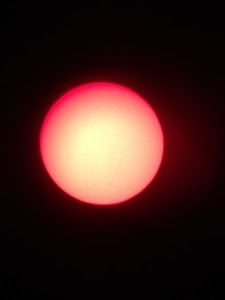
The author shot this photo of the Sun using an
iPhone attachment to a solar scope set up in the
Cloud Break Optics parking lot.
Photo: Greg Scheiderer.
The hands-on approach is important. As we talked about their plans for the shop we discussed astrophotography and the challenges I’ve had getting good photos with my smartphone. We soon had a solar telescope set up in the Cloud Break Optics parking lot and I was taking pics with the help of a nifty phone attachment. You get a better sense for the various telescopes and gear when you can actually see them, touch them, and use them. You just can’t get that experience online.

The challenges of a brick-and-mortar store

Anderson and Dahl recognize that a huge chunk of the sales of astronomy gear these days happens online, and so they are doing Internet sales and shipping globally.

“We have to compete in that market,” Dahl explained. “At the same time we wanted to provide a customer service experience” for people local to the Seattle area.

“We want them to come into the shop, talk to us, give them the advice and the expertise and the knowledge that we have,” he said. “At the same time we can provide as much of that as possible on our website.”

You can follow Cloud Break Optics on Twitter, Facebook, and Instagram. Drop by the shop at 2821 NW Market Street in Ballard, and watch for news of their upcoming grand opening celebration. They’ll be at Table Mountain again next week, this time with their vendor hats on. We expect they’ll work in a little observing as well.

February 22, 2015

An evening with famed comet hunter Don Machholz

In an age when automated programs are scanning the night sky using high-tech telescopes, CCD cameras, and computing power to find near-Earth objects, Don Machholz continues to search for comets the old-fashioned way.

Seattle Astronomy’s Greg Scheiderer, left, with comet hunter
Don Machholz at the Seattle Astronomical Society’s annual
banquet. Photo: Greg Scheiderer.
“I do it visually,” Machholz explained at the annual banquet of the Seattle Astronomical Society last month. “I do not use cameras, I do not use CCDs. I look through the eyepiece and I push the telescope.”

Machholz is the record holder, with eleven comets discovered visually since he started his hunt in the mid-1970s. That doesn’t sound like so many, but consider this: according to the Catalog of Comet Discoveries, there have been 1,502 comets discovered since 2005. Of those, just three have been discovered visually. The Panoramic Survey Telescope & Rapid Response System (Pan-STARRS) got full or shared credit for thirty-three comet discoveries last year alone. The last time a comet was discovered visually was in 2010, when there were two, and Machholz bagged one of those.

There’s a little bit of luck involved in comet hunting. Machholz jokes that the first thing you need to do to find a comet is to be looking where it is in the 40,000 square degrees of sky. But he has a system. He checks websites to figure out where the programs like Pan-STARRS are looking on a particular night and then conducts his hunt in a different part of the sky. Machholz divides the sky into sections, and makes telescope sweeps covering about fifteen degrees at a time. Then moves down about a half field of view and sweeps again. He keeps meticulous records of his searches.

“It sounds boring, but you get to see a different part of the sky all the time,” Machholz said.

He got interested in astronomy as a boy. His father was a naval navigator and had a book with star charts that Don used to learn the sky. When he was about eight years old his sister brought home a book about meteors that piqued his interest. Finally, Machholz received a telescope for his thirteenth birthday. On the third night out he found Saturn.

“I could see the rings on it,” he recalled, thinking stargazing might not be such a bad hobby. He was hooked.

A family tragedy helped drive Machholz’s comet-hunting program early on. In 1976 his brother, an avid skier, was killed in an avalanche. Machholz found himself depressed, with insomnia, sleeping just a few hours a night, but with lots of energy.

“That’s kind of the ideal ingredients for a comet hunter,” he said. “For the next three or four years my comet hunting program developed to a greater and greater depth. Comet hunting wasn’t just something I did, it became part of who I am.”

His early comet hunting was done from his parents’ back yard and other locations around Concord, California. After moving to San Jose in 1976 he did much of his observing from nearby Loma Prieta mountain. In 1990 he moved to Colfax, California and built an observatory there.

After so much time at the eyepiece, Machholz says his heart still skips a beat or two when he thinks he has found a new comet.

“It’s a very important moment,” he said. “First I want to remember what song was on the radio.” He always has the radio playing when he hunts, and his presentation was full of music from the Rolling Stones and the Beatles to Phil Collins and Cyndi Lauper. He adds, though, that there’s no time for jumping up and down when he finds a comet, because there’s serious work to do.

“You don’t want to lose it,” he explained. “You might have it in the field now, but if you bump the telescope or let too much time go by and it drifts out of the field, you have to be able to find it again.”

“You have to be sure you know where you’re looking, make sure it’s not a galaxy or a cluster,” he added. He double checks with his star atlas, makes a drawing that puts the comet in its position compared to the field of stars, and watches to see if it moves. If all that checks out he reports the discovery by email, phone, and fax.

Comet 96/P Machholz as seen by the 
HI-2 camera on the STEREO-A spacecraft.
Of all of his discoveries, Machholz said comet is 96P/Machholz is his favorite.

“It is an amazing comet; it has its own Facebook page,” he said.

The orbit of 96/P Machholz changes because of the influence of Jupiter, and the perturbations have some scientists thinking there may be large undiscovered planets way out beyond Pluto. The comet also is low on carbon and cyanogen. This hasn’t been explained, though the leading ideas are that it may have originated in another solar system, or been exposed to temperature extremes that changed its chemical composition.

It was a pleasure to spend an evening with Don Machholz. His lively presentation was full of humor and had the banquet audience laughing and engaged.

August 17, 2014

Pops, the Perseids, and a trip back in time

August always makes me wistful these days, and its all because of my father and the Perseid meteor shower.

When I was 12 years old, about to turn 13, I was on a backpacking trip in the Washington Cascade Mountains with my Boy Scout troop and my dad, who was an avid hiker and later our Scoutmaster. By coincidence the hike was in early August. We had some heavy rain during the early part of our adventure, but one night, camped near the small village of Holden, the weather was glorious, the night was crystal clear, and we slept out under the stars. As the sky darkened to the pitch black of the deep wilderness, far away from population centers, we marveled at the near constant stream of shooting stars; it wasn’t planned, and I don’t think any of us even knew they had a name, but Perseid meteors of many colors sizzled through the sky. I don’t think I could have counted them; there must have been a hundred or more every hour!

The author, at right, with his father near Image
Lake after climbing Miner’s Ridge on a hike
in August 1970. Rain and clouds went away later
in the week, enabling the best possible view
of the Perseid meteor shower.
It was a sight like none any of us had ever seen, coming from the Seattle suburb of Renton, light polluted even then. It was a night I will never forget.

Part of the magic of astronomy is the perspective it gives us about time. We see the Moon as it looked about a second ago, the Sun as it was eight minutes in the past, and M31, on a collision course with us, as it looked 2.5 million years ago. The Hubble Space Telescope brings us views of things as they looked close to the birth of the universe.

Every time I see a meteor I’m transported back to 1970, in my sleeping bag in a wilderness clearing, watching hundreds of meteors shoot through the sky, on a hike with my father, who is young, vital, and alive.

Dad passed away in mid-August of 2000, just a few days after the peak of that year’s Perseid shower. The anniversary always makes me look back, and up.
My backyard in West Seattle isn’t ideal for meteor watching. For one thing, it’s in Seattle, where it’s usually cloudy, and if it’s not the city lights wash out all but the brightest of the Perseids. Still, ever the optimist, I always go out and look, just in case. This year was worse than usual for Perseid viewing. The Moon was near full, and though we’ve had a stretch of favorable weather this summer, there were thunderstorms and heavy rain the early morning of the Perseid peak. Shut out again.

The next evening was mostly clear, though, and I went out, grabbed a chair on the deck, and waited just to see if any stragglers would show up. It took about 20 minutes before a fabulous, bright Perseid blazed across the sky.

The astronomy buff in me knows that this meteor was just a little chunk of the ancient comet Swift-Tuttle, itself possibly a piece of the stuff of which the solar system is made. My inner 12-year-old viewed it as a signal from Pops. Things are all right, buddy. Keep looking up.

I have a great life. My wonderful wife tolerates and encourages my astronomy hobby, even though she’s not about to come out and freeze her tail off for a glimpse of the Cassini Division. We have a nice consulting practice, and sometimes people publish my writing. I don’t want to be 12 again. But I like having a time machine that takes me back to spend a little more time with the old man every once in a while.

I miss you, Pops.

January 6, 2014

Spokane astronomer competes for title of King of the Nerds

Spokane astronomer Kayla LaFrance hopes to help run missions to Mars or even walk on the Red Planet herself one day. Her short-term goal is to be recognized as one of the nation’s top geeks. LaFrance, a member of the Spokane Astronomical Society, will be a contestant on the second season of the television show “King of the Nerds,” which airs on TBS beginning Jan. 23. It’s not just a title; the person proclaimed monarch of dweebiness will receive a prize of $100,000.

Kayla LaFrance. Photo courtesy of
Trae Patton, Turner Entertainment Networks.
LaFrance isn’t your garden-variety nerd; while she describes herself as a “typical kid out of college with no career,” she has legitimate astronomy credibility. In May 2012 she finished work on her master’s degree in space studies at the University of North Dakota, where she did independent research on the organization of Mission Control for the surface exploration of Mars. She earned a bachelor’s degree in engineering physics, with minors in mathematics and public relations, from Belmont University in Nashville, Tennessee.

Those raised on Sesame Street may be thinking that one of those things is not like the others, but for LaFrance the PR minor meshed well with her interests.

“Sidewalk astronomy has always been a huge part of what I really enjoy doing,” LaFrance explained. “I thought public relations would be a good way to help me hone my skills at the telescope—helping little kids get into astronomy, helping parents figure out what’s going on, dealing with conspiracy theorists—it’s been a very big part of my time with the astronomy club.”

The Astronomical League has recognized LaFrance for her enthusiasm for outreach, twice presenting her with its Jack Horkheimer Award for Exceptional Service by a Young Astronomer—a first place award in 2003, and second place in 2002. More than a decade ago, the league’s articles about the awards noted LaFrance’s plan to visit Mars.

Star Trek captured LaFrance’s fancy when she was a little girl, and she’s been hooked on space ever since. Her seventh-grade teacher at Greenacres Junior High in Spokane Valley, Thomas Herrmann, launched her on her astronomy trajectory.

“[He] challenged me to stop looking at just the TV and start looking at what was really up there,” LaFrance said of Herrmann. “He showed me stuff with his telescope and started everything.”

She joined the Spokane Astronomical Society shortly thereafter and has been an active participant ever since, excepting for when she has been away at college. She frequently gives talks to the club, usually about Mars.

LaFrance made the cut for “King of the Nerds” last year, but passed when an even cooler opportunity presented itself. She scored an internship with the NASA Ames Academy for Space Exploration, where she did research on composites that represent science’s best guess about what Mars soil is like, based on data from various robotic missions. She was free for season two of the program, the producers were still interested, and she filmed episodes of the show last summer in Los Angeles.

“It was the best experience that I’ve participated in to date, and I’ve done some pretty cool stuff and seen some cool stuff,” LaFrance said. “I loved every moment of it. It was also the most challenging and stressful event of my life.”

LaFrance said her focus on Mars stems from her interest in human space exploration.

“The next logical step, in my opinion, is Mars, so I devoted a lot of my research time in college to the purpose of sending humans to Mars,” she said. “I’ve long been fascinated my Mission Control and how they operate and how they support crews in space. Of course if I could go into space I would definitely do it, but ultimately I would like to be flight director for missions on Mars.”

LaFrance plans to pursue a Ph.D. degree some day, but figures she needs more practical experience first, so will be looking for work with government or private agencies involved in aerospace and mission operations.

In the meantime, watch for her on “King of the Nerds.” The program, hosted by Robert Carradine and Curtis Armstrong, two of the stars of the 1984 film “Revenge of the Nerds” and its sequels, airs Thursday nights beginning Jan. 23. It will be on at 10 p.m. in Spokane, but, as they say, check your local listings. Keep an eye on Mission Control, too. I wouldn’t be surprised to see LaFrance turn up there sooner than later.