 |
| The NASA/ESA Hubble Space Telescope’s Wide Field Camera 3 observed Saturn on 20 June 2019 as the planet made its closest approach to Earth this year, at approximately 1.36 billion kilometers (845 million miles) away. (Photo: NASA, ESA, A. Simon (Goddard Space Flight Center), and M.H. Wong (University of California, Berkeley)) |

Space and astronomy news from Seattle and the Northwest
Showing posts with label photography. Show all posts
Showing posts with label photography. Show all posts
September 12, 2019
Hubble's latest pic of Saturn is a pretty good one

February 9, 2018
Astronomy's neglected stepchild
 |
| Astrophotographer and author Robert Reeves was the guest speaker at the annual banquet of the Seattle Astronomical Society on Jan. 28, 2018. Photo: Greg Scheiderer |
Reeves was interested in the Moon even before there was a space program. We were all agog during the race to land on the Moon, but when the race was won many moved on to other things.
“Back then American heroes rode a pillar of fire and dared to set foot on another world,” Reeves said. “The scientific mindset, the desire to explore the solar system was there. That was a time when America was only limited by its imagination; we could do anything we wanted to do.”
Alas, Reeves notes, politics is different now.
“America has lots its will, it’s lost the guts to go into deep space,” he said. “We’ve been rooted in low-Earth orbit for four decades.”
“Space exploration is not the same, but the Moon that we wanted to go to still beckons us,” he added.
Bringing the Moon back
Reeves’s talk was titled Earth’s Moon: Astronomy’s Neglected Stepchild. He aims to turn that around.“I’m here to bring the Moon back,” he said. “The Moon is still a viable target; we can see it from our own back yard.”
Reeves is a prolific writer about astronomy. His first published article appeared in Astronomy magazine in 1984. Since then he’s written some 250 magazine articles and 175 newspaper columns about the topic. In fact, just days after his talk here the March 2018 issue of Astronomy arrived, including an article and photos by Reeves about hunting for exoplanets. His mug also appears, along with one of his lunar photographs, on a back-cover advertisement for Celestron.
Reeves has written five books in all, including three how-to manuals about astrophotography: Wide-Field Astrophotography: Exposing the Universe Starting With a Common Camera (1999), Introduction to Webcam Astrophotography: Imaging the Universe With the Amazing, Affordable Webcam (2006), and Introduction To Digital Astrophotography: Imaging The Universe With A Digital Camera (2012). All are from Willmann-Bell.
Reeves feels the webcam book helped launch a whole industry and trained a generation of astrophotographers. He points out that back in the 1960s you could count the number of good astrophotographers with the fingers of one hand. Now there are thousands of people turning out great images, and they all get to use superior gear.
“Amateur instruments off the shelf today just blow away what the pros used to do on the Moon, and it’s relatively easy to do this,” Reeves said. I asked Reeves if he laments the passing of film photography. He said he did, a little, noting with a laugh that he has four decades worth of photography that is obsolete! But he said the fact that he can turn out more better-quality images in less time with digital makes up for that.
Check out Reeves’s website for a image-processing tutorial, to buy prints and posters, and find lots of other lunar photography information.
Asteroid 26591 is named Robertreeves and asteroid 26592 is named Maryrenfro after his wife; Renfro is her maiden name. It is believed they are the only husband and wife with sequentially numbered asteroids named after them! Robert noted that his takes about four years to orbit the Sun, while Mary’s goes around in about 4.4 years.
“Every ten years I catch up to her,” he said, “so for eternity I’m going to be chasing Mary around the solar system.”
###


February 5, 2016
Local photographer published in S&T
 |
| Matt Dahl’s photo of the Rosette Nebula is included in the reader gallery section of the March 2016 issue of Sky & Telescope magazine. |
Dahl created the photo from more than 13 hours of exposures collected over two nights about a year ago.
“It’s a lot of work, a lot of time in the cold, and even more time in the warmth post-processing,” he said. “It requires a lot of time to get the detail that you want.”
“It’s definitely a process but it’s nice when it pays off,” Dahl added.
Interestingly enough, the gallery includes two shots of the Rosette, making for a nice comparison of the different results photographers can get depending on the filters they use and other techniques.
Photos, or just looking?
Dahl enjoys visual observing as well as astrophotography.“One of the things I really like about imaging is that I have a goal and I get a product at the end,” he said. “I like the visual aspect, I like to be able to look at stuff. But there’s this whole process I go through. It’s somewhat cathartic, despite the fact that it takes a long time to do it. I really enjoy, and I find very relaxing, just sitting with my scope—or having my scope running, and sleeping!”
Dahl feels that amateur astronomers are making images that rival what professional observatories were turning out two decades ago, and they’re doing it with cameras that can cost as little as a few hundred dollars.
“The technology, both in its advancement but also in its affordability to the amateur, has been impressive,” he noted. “It’s nice to have this available as a means for enjoying the hobby.”
The March issue of Sky & Telescope is on the newsstands now. You can see some of Dahl’s other images on his Flickr page.
June 23, 2015
Big plans for satellite imaging company BlackSky Global
The latest Seattle-based entry into the private space business has announced ambitious plans to offer up “satellite imaging as a service,” selling color photos with one-meter resolution at a significantly lower cost and with far less turnaround time than is presently available in the market. BlackSky Global is aiming to launch two of its Pathfinder imaging satellites in the first quarter of next year and has the funding available to have a total of six of them up in orbit by the end of 2016. BlackSky’s long-term plan is to have a constellation of 60 high-resolution imaging satellites in operation by 2019.
“We’re laying out the systems so that we’ll be able to take a picture essentially of anywhere on the planet and send it back to a customer on a timeline measured in minutes, and be able to do that at consumer kind of prices,” said Peter Wegner, chief technology officer for BlackSky. “It really is exciting; it’s something that’s never been possible before.”
The typical buyers of satellite images are governments, corporations, and other large entities working on security, border defense, environmental monitoring, and precision agriculture. Wegner expects those, and more, to be BlackSky customers.
“It’s going to open up all kinds of new markets, too,” he said. “There are a number of firms around the world that use satellite imagery to do analytical predictions of commodities or natural resources, energy. It really is, in some sense, about global market intelligence and feeding the demand to know what’s happening around the world everywhere, all the time, 24-7.”
Eventually it will be a consumer business. You could go onto the BlackSky website and, for a few hundred dollars, order up a photo of your backyard. The one-meter resolution of the images will reveal people or groups of people, but they won’t be identifiable.
“That’s important because there are a lot of concerns about privacy, and we also have those concerns as a company,” Wegner said. “This allows us to provide the capability to monitor what’s happening around your environment, but not get down to the level where it causes a privacy concern.”
BlackSky is an independent company owned by Seattle’s Spaceflight Industries, which specializes in launching small satellites as secondary payloads. Wegner said Seattle is a great place for BlackSky’s sort of business.
“There seems to be a growing center of gravity for small space companies to move to Seattle,” he said, noting that the mix of aerospace, high-tech, and web expertise is perfect.
“All three of those things are really important for our business, because if you’re going to make this a consumer-level product, you need the web-scale business experience, you need the big data experience, and you need the aerospace experience, which all fits uniquely where we are in this area.”
 |
| Peter Wegner. Photo: BlackSky Global. |
The typical buyers of satellite images are governments, corporations, and other large entities working on security, border defense, environmental monitoring, and precision agriculture. Wegner expects those, and more, to be BlackSky customers.
“It’s going to open up all kinds of new markets, too,” he said. “There are a number of firms around the world that use satellite imagery to do analytical predictions of commodities or natural resources, energy. It really is, in some sense, about global market intelligence and feeding the demand to know what’s happening around the world everywhere, all the time, 24-7.”
Eventually it will be a consumer business. You could go onto the BlackSky website and, for a few hundred dollars, order up a photo of your backyard. The one-meter resolution of the images will reveal people or groups of people, but they won’t be identifiable.
 |
| Technician Jim Bowes checks out the Pathfinder spacecraft. Photo: BlackSky Global. |
BlackSky is an independent company owned by Seattle’s Spaceflight Industries, which specializes in launching small satellites as secondary payloads. Wegner said Seattle is a great place for BlackSky’s sort of business.
“There seems to be a growing center of gravity for small space companies to move to Seattle,” he said, noting that the mix of aerospace, high-tech, and web expertise is perfect.
“All three of those things are really important for our business, because if you’re going to make this a consumer-level product, you need the web-scale business experience, you need the big data experience, and you need the aerospace experience, which all fits uniquely where we are in this area.”
June 20, 2015
Book review: Photography Night Sky
 (Mountaineers Books, 2014) is an interesting read.
 Authored by Jennifer Wu and James Martin, Photography Night Sky is not a guide for deep-sky photography, but rather a primer for shooting nightscapes, including stars, the Milky Way, star trails, the Moon, and twilight scenes. Wu and Martin also cover meteors, aurorae, false dawn, and other celestial phenomena.
The 100 gorgeous color photos included in the book are proof enough that the authors know what they’re talking about. They have the credentials to back it up, too. Wu has won a bevy of awards for her work and is a Canon “Explorer of Light” photographer. Martin has written and photographed professionally since 1989 and is the author of several books, including the best-selling Photography Outdoors: A Field Guide for Travel and Adventure Photographers
 , which had a new release last year.
Photography Night Sky is a highly accessible guide for the novice shooter, and we expect seasoned photographers also will find some good pointers within. Wu and Martin cover equipment and preparation for shooting, and get into such topics as composition, focus, and optimum camera settings for various conditions. They also address some of the challenges of photography at night, especially shooting in the cold. The book includes chapters about the various sorts of objects one might shoot in the dark, and a full chapter about post-processing of images.
We were especially interested in the sections about lighting and the methods, such as light painting, for enhancing the appearance of objects at night without washing out the stars you’re trying to capture in your images.
Wu was in Seattle to give a talk last month, but we had to miss it, as it was scheduled at the same time as a lecture by renowned cosmologist Jim Peebles. But we’re glad to have a copy of Photography Night Sky, and hope the advice from Wu and Martin will help improve our own imaging. Pick up a copy at the link or by clicking the cover photo above.
More:
February 9, 2014
Half the park is after dark
Tyler Nordgren wears many hats: astronomy professor, author, artist, photographer, national park curriculum designer, and night-sky ambassador. The author of Stars Above, Earth Below: A Guide to Astronomy in the National Parks was the keynote speaker at the recent annual banquet of the Seattle Astronomical Society.
Nordgren, a professor of astronomy and physics at the University of Redlands in California, pegs his early interest in astronomy to his suburban-Portland grade school principal, who happened to be the uncle of astronaut Bonnie Dunbar. Mr. Dunbar used his connections to bring NASA folks to the school for talks. Nordgren decided then that he wanted to be an astronaut, too. Then he was amazed by Carl Sagan’s TV series.
“When I saw Cosmos I realized why I wanted to be an astronaut, or if not an astronaut, to be an astronomer,” Nordgren said.
Coincidentally, Nordgren attended graduate school at Cornell University when Sagan was on the faculty. He never took a class from Sagan, but in one of his first teaching gigs Jeremy Sagan, Carl’s son, was in Nordgren’s class. He said Jeremy sat in the front row, asked a lot of questions, and then talked over the lectures with his famous dad. No pressure there.
“I learned to be on my toes!” Nordgren joked.
A couple of events inspired Nordgren’s work in the national parks, which includes marvelous photography and a series of travel posters based on the style of the 1930s WPA graphics. The first was a visit to Palomar Observatory.
“My very first telescope was an eight-inch Celestron my father bought for me when I graduated from college,” Nordgren recalled. “My second telescope was the Palomar 200-inch” which he used in research about dark matter in spiral galaxies. When he returned 10 years later he was taken aback by the increased light pollution fueled by a housing boom in the area.
“It had been like a tidal wave of light had just swept out around the mountain,” he said. “It was stunning just how bad the skies now were at Palomar.”
Shortly after that trip, Nordgren celebrated gaining tenure by taking a trip to Yosemite National Park and attended an evening ranger talk about astronomy.
“For many, many people this was the first time they had seen a night sky, a truly pristine night sky,” Nordgren marveled.
He decided to spend an upcoming sabbatical in the National Park system helping rangers develop programs for park visitors to experience the night sky. He spent time in a dozen different parks over the course of 14 months, and came to realize that the preservation of the land that prevents development in the parks also, almost by accident, preserves the precious resource of truly dark skies. It’s a growing part of the appeal of the parks, articulated by the slogan “Half the park is after dark.”
“In those parks that offer night-sky programs the attendance they have is equal to if not better than the next two types of programs added together,” Nordgren noted. “Far and away these are the most popular ranger programs that are offered.”
Much of Nordgren’s work is to link what people can see in the sky to what they see in the national parks. For example, he compares Mars to parks in the American Southwest; both Earth and the Red Planet have similar geology and chemistry. Yellowstone National Park has numerous geysers, similar to those on Saturn’s icy moon Enceladus.
One of Nordgren’s favorite parks is the Chaco Culture National Historical Park in New Mexico, which was recognized last year as an International Dark Sky Park by the International Dark-Sky Association. He noted that many of the ancient structures there serve as astronomical markers ala Stonehenge.
“People paid attention to the sky, people have been doing that for centuries, millennia,” Nordgren said. “Unfortunately we’ve made it tremendously difficult to keep doing that.”
As evidence he showed a photo of the sky above Chaco, which is still impressively dark and starry, but all around light pollution is encroaching from the cities of Gallup, Crownpoint, Albuquerque, and a nearby coal mine. Thus a big part of his aim is to get communities near the parks to recognize that the night sky is an attraction, and to encourage them to be good stewards of the dark sky. His spiel goes just as well for any city, regardless of its proximity to a national park.
 “All that light that shines above the horizon doesn’t do anything useful,” Nordgren said. “So why are we lighting up the sky? There is nothing we need fear up there, so why are we paying for that light? Why are we generating that light? Why are we burning the natural resources to create that light?”
There really aren’t great answers to those questions, and Nordgren said the solutions are within reach.
“This can be a win-win situation for all of us,” he said. “We can get the stars back, we can save money, we can save natural resources. It really doesn’t have to be stars versus safety.”
Check out Nordgren’s posters and other artwork on his website.
was the keynote speaker at the recent annual banquet of the Seattle Astronomical Society.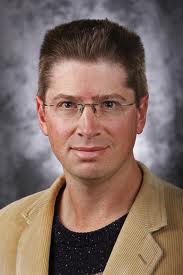 |
| Tyler Nordgren |
“When I saw Cosmos I realized why I wanted to be an astronaut, or if not an astronaut, to be an astronomer,” Nordgren said.
Coincidentally, Nordgren attended graduate school at Cornell University when Sagan was on the faculty. He never took a class from Sagan, but in one of his first teaching gigs Jeremy Sagan, Carl’s son, was in Nordgren’s class. He said Jeremy sat in the front row, asked a lot of questions, and then talked over the lectures with his famous dad. No pressure there.
“I learned to be on my toes!” Nordgren joked.
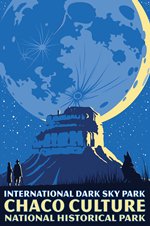 |
| Nordgren’s posters like this one for Chaco Culture National Historical Park help call attention to the importance of dark night skies in the parks. |
“My very first telescope was an eight-inch Celestron my father bought for me when I graduated from college,” Nordgren recalled. “My second telescope was the Palomar 200-inch” which he used in research about dark matter in spiral galaxies. When he returned 10 years later he was taken aback by the increased light pollution fueled by a housing boom in the area.
“It had been like a tidal wave of light had just swept out around the mountain,” he said. “It was stunning just how bad the skies now were at Palomar.”
Shortly after that trip, Nordgren celebrated gaining tenure by taking a trip to Yosemite National Park and attended an evening ranger talk about astronomy.
“For many, many people this was the first time they had seen a night sky, a truly pristine night sky,” Nordgren marveled.
He decided to spend an upcoming sabbatical in the National Park system helping rangers develop programs for park visitors to experience the night sky. He spent time in a dozen different parks over the course of 14 months, and came to realize that the preservation of the land that prevents development in the parks also, almost by accident, preserves the precious resource of truly dark skies. It’s a growing part of the appeal of the parks, articulated by the slogan “Half the park is after dark.”
“In those parks that offer night-sky programs the attendance they have is equal to if not better than the next two types of programs added together,” Nordgren noted. “Far and away these are the most popular ranger programs that are offered.”
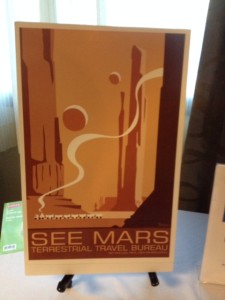 |
| Nordgren's Mars poster |
One of Nordgren’s favorite parks is the Chaco Culture National Historical Park in New Mexico, which was recognized last year as an International Dark Sky Park by the International Dark-Sky Association. He noted that many of the ancient structures there serve as astronomical markers ala Stonehenge.
“People paid attention to the sky, people have been doing that for centuries, millennia,” Nordgren said. “Unfortunately we’ve made it tremendously difficult to keep doing that.”
As evidence he showed a photo of the sky above Chaco, which is still impressively dark and starry, but all around light pollution is encroaching from the cities of Gallup, Crownpoint, Albuquerque, and a nearby coal mine. Thus a big part of his aim is to get communities near the parks to recognize that the night sky is an attraction, and to encourage them to be good stewards of the dark sky. His spiel goes just as well for any city, regardless of its proximity to a national park.
“All that light that shines above the horizon doesn’t do anything useful,” Nordgren said. “So why are we lighting up the sky? There is nothing we need fear up there, so why are we paying for that light? Why are we generating that light? Why are we burning the natural resources to create that light?”There really aren’t great answers to those questions, and Nordgren said the solutions are within reach.
“This can be a win-win situation for all of us,” he said. “We can get the stars back, we can save money, we can save natural resources. It really doesn’t have to be stars versus safety.”
Check out Nordgren’s posters and other artwork on his website.
October 22, 2013
Samammish astronomer uses video to share the WOW factor
When his niece developed an interest in space at a young age, Cook’s sister looked around for educational materials suitable for a youngster. She didn’t find much. Her plan B: “Ask Uncle Ted.”
“I thought if nothing is out there, maybe I can start to put together some stuff and put it out there for kids,” Cook recalled.
He had a bit of a head start. A history buff, Cook already had created a series of videos about Washington state history, animated episodes in which characters Herc, Velocity, and their dog Laika visited people and places from the state’s past.
“I had these characters created, and I had this whole setup, and I thought how about if we move to what I really love, which is astronomy,” Cook said.
Between 2006 and 2008 Ted Cook Productions created three astronomy DVDs, which were sold at museums and planetariums around the country. These three, along with his four state-history disks, are still available for sale on his website. Because of the challenges of producing and distributing physical disks, and the growth of YouTube and other services, he decided to put new astronomy videos online. In addition, this year Cook embarked on an ambitious plan of producing four educational pieces every month, under the banner of “Let’s Explore Astronomy.” Three of them will be videos: one about astronomy history, one about the how-to’s of the hobby, and one about what can be seen in the night sky in that particular month. A fourth piece will be a written recap of astronomy news for the previous month. He’s done about five of each so far.
This month, for example, Cook’s “Andromeda Time-Slip Theater” is taking a look at Mars: Herc and Velocity listen to part of the famed Orson Welles radio drama about a Martian invasion.
“They’re talking about Percival Lowell and the canals, and ‘The War of the Worlds,’ and then what the rovers found,” Cook said. “We look at how we moved from Percival Lowell thinking he’d found canals on Mars to finding there was once water there.” Take a look:
Cook said he aims to make the videos accessible for kids in about 5th or 6th grade, but wants adults to be able to get something out of them, too.
“I wanted to make it so that someone who is just getting into astronomy or wants to know more about it can learn without it being total mathematics,” Cook explained.
Cook hopes to keep the videos free, and is offering them to astronomy clubs around the country to use in their outreach efforts. He’s considering creating accompanying curriculum and hands-on activities that could be used in classrooms or for any youngster who wants to learn more about space. He’s already developed a game that he uses for outreach events with younger kids, in which they can learn about order of the planets and some facts about each one.
Making it a paying enterprise may take some doing. Cook has a couple of sponsors for the videos and may pursue grant funding or other ways to help offset the costs of creating the programs.
It was almost inevitable that Cook would be interested in space.
“My dad worked at the Kennedy Space Center during the Apollo days, so that was my playground when I was a kid,” he said. “I was inspired because I was there. I saw it every day.”
“I was hooked, I knew all of the astronauts’ names,” Cook added.
Cook actually is a rocket scientist; he earned a degree in aerospace engineering at Georgia Tech, but later studied photography at UCLA. He’s been in that business as a shooter and a teacher for some 30 years. But he still maintains a sense of wonder and awe when talking about astronomy and space.
“It is the new frontier, it has the wow factor,” Cook said as he explained his passion for outreach and getting others interested in the hobby, or perhaps in astronomy as a career. “You’re looking at these things going WOW! That’s cool! I think that has a lot to do with it. The people respond because of the wow factor.”
There’s a lovely completed circle in this story. Cook’s niece Delenn Larsen, the little girl who launched him on this trajectory, is now 13 years old and remains interested in space and astronomy. In fact, she is the voice of the character Velocity in the videos!
In addition to educational videos, Ted Cook Productions also offers astronomy tours of New Mexico, a venture on which Cook is teamed with Dr. Alan Hale, the co-discoverer of Comet Hale-Bopp.
You can check out Cook’s videos on YouTube or on the Ted Cook Productions website. Spread the word to the young space nuts in your universe.
July 29, 2013
The eyes of Mars visit Queen Anne
 |
| Dr. Melissa Rice of Caltech spoke about the Mars Rovers at a Queen Anne Science Café event in July. Photo: Greg Scheiderer. |
It was a good homecoming for Rice who, like Planetary Society CEO Bill Nye “The Science Guy”, got her start at the Pacific Science Center.
“As a kid I came many, many times and loved it, and that’s where the seeds were planted that led me here working on these Mars missions today,” Rice said. “I feel really honored to be back here, paying it forward, planting some seeds for some of the next generation that is here with us tonight.”
 |
| Rice and solar system ambassador Ron Hobbs both love this photo of a sunset on Mars, snapped by the Spirit rover in 2005. Photo: NASA. |
Rice hopes humans visit Mars some day, though she would not make a very good travel agent.
“Mars is a pretty awful place,” she said. “It’s a dry, desolate, barren wasteland.” The reason to go is to answer the big questions about life somewhere besides Earth.
“If we do find that Mars is a place where life could have survived, and if we do eventually send spacecraft to Mars that bring samples back, and we find evidence for ancient microbial communities on Mars, then we know we’re not alone, and that’s about as profound a thing that I can imagine happening in my lifetime,” Rice said.
She’s fond of her Mars robots, but says they do have their drawbacks. Curiosity, for example, when it’s driving on automatic navigation can only travel about 200 meters per day. The rover has to analyze a lot of data before every turn of the wheels to pick the most trouble-free route.
“The rover is thinking so hard that it doesn’t have time to drive any faster,” Rice quipped. The speed points out one reason that she’d like to see people on Mars some day.
“What those rovers have done in eight years a human could do in a couple of days,” Rice said. She’s excited for NASA’s proposed 2020 Mars mission, a Curiosity-class rover that would address key questions about the potential for life on Mars, and pave the way for human exploration.
Rice was moved to start on this great adventure, a career in space exploration, by a video she saw during a high school astronomy class. The video depicted how the Sun would one day run out and our solar system would be no more. But the universe would roll on.
“That is what inspired me to study astronomy,” Rice said. “This thing that is greater than ourselves will be around longer than any of us will.”
You can watch Rice’s entire presentation on the KCTS-9 website.
March 17, 2013
PanSTARRS peeks through Seattle clouds
As sunset approached yesterday things were looking hopeful in the west from West Seattle, though there were clouds building on the horizon. Seattle Astronomy dashed down to the south end of Alki Beach Park, near the Charles Richey Sr. Viewpoint, to hunt for PanSTARRS. Binoculars in hand, I swept the areas between the clouds and–Eureka!–finally spotted the comet, probably around 8:10 p.m., as I posted this tweet at 8:17:
Success! PanSTARRS spotted from West Seattle!— Seattle Astronomy (@SeattleAstro) March 17, 2013
I am still amazed at the little gasp of discovery I get whenever I spot a new celestial object, or even familiar ones. I probably had 10 minutes of viewing, maybe a little more, before PanSTARRS was swallowed up by a large black cloud, not to be seen again. It was a pretty sight, with a definite tail shooting up maybe a degree or two. I would rank it my second-best ever city comet, after the spectacular McNaught of 2007, which was spotted under similar circumstances between clouds that year.
I was not able to see PanSTARRS with the naked eye yesterday, though I expect had there been just a few more minutes for it to get a little darker, I could have. I may try again this evening; as I write this, a little after noon, the sky is mostly clear. But a lot can change between now and sunset, about six hours hence.
 |
| This Sky & Telescope diagram and article are a good guide for viewing Comet PanSTARRS, at least for the next few days. |
Sorin, the Soggy Astronomer, posted several photos from the evening on his Flickr stream. Jason Enevoldsen caught a photo the day before, posted by his spouse on her Alice’s Astro Info site. The Enevoldsens were planning to be down at Seattle’s Lincoln Park last night, though we’ve received no dispatches as of this moment.
So, keep hunting, Seattle comet seekers! It can be done. PanSTARRS is getting further from the Sun, and thus fainter, each day. But good views should be had for a while yet.
June 9, 2012
Transit of Venus
What a great day June 5 turned out to be! My three-day trek to see one of the rarest predictable astronomical events was a success, and I had a marvelous time watching Venus in transit across the face of the Sun.
The beginning of the day didn’t look very promising. I awoke at about 6 a.m. in Canyonville, Oregon and looked out the window to see pouring rain. I looked at several online weather forecasts, and the outlook had worsened a bit since my last check the previous evening. Still, the prediction was for mostly sunny skies in my target area of Red Bluff, California.
The rain had let up some by the time I hit I-5 southbound at 7:30, but the overcast was complete. Clouds predominated the trip through the Siskiyou and Klamath Mountains; Mt. Shasta was completely socked in, and it was raining off and on as I worked my way south. Once I cleared Shasta Lake and headed into Redding and the Sacramento Valley, the clouds parted somewhat, but there was reason to worry. There was some nasty looking rain in the hills to the west, and plenty of clouds dotted the sky in Redding.
I pushed south. I had targeted Red Bluff as my viewing site because it was the closest spot with a forecast that gave good odds for transit viewing. The National Weather Service had it at less than 20 percent cloud cover for the afternoon. I’d done some internet searching and had three candidate viewing sites in mind: an I-5 rest stop just north of Red Bluff, a city park on the river in downtown Red Bluff, and the Woodson Bridge State Recreation Area just east of Corning, the next town south of Red Bluff. If none of those worked out, or if the weather looked iffy, I could probably get at least as far as Sacramento before the transit began.
 I checked out the rest stop, but it had too many trees and limited views to the west. The city park in Red Bluff was OK, but also had lots of obstructions. So I headed for Corning. I got to the state park, and it was closed, with a locked gate across the driveway! (Shouldn’t that be noted on the website?) However, Tehama County River Park was just on the other side of the highway, and it was open! It turned out to be perfect! The park is right on the Sacramento River, has a good view to the west, and hardly anyone else was there. There was still a big rain storm to the west, but it looked like it was moving north, so a little after 1 p.m. I decided that Tehama was my place. I still couldn’t stop thinking how badly it would suck if the rain moved in on my California vantage point while there were clear skies back home in West Seattle. Was Captain Cook all wigged out about the weather when he went all the way to Tahiti to view the Venus transit in 1769?
By 2 p.m. I had my telescope set up and collimated, and so had about an hour just to chill and have a little lunch before the transit began. I shortly was visited by the manager of the park, who wanted to find out what I was up to. (A Dobsonian telescope looks a little like a cannon, or a water heater, depending on the direction in which it is pointed.) When I explained that I’d driven all the way from Seattle to find the Sun in order to watch the transit of Venus, this seemed to satisfy, if not necessarily interest, him. He mentioned that, a couple of weeks ago, this same park was packed wall-to-wall with people viewing the annular eclipse of the Sun. (It was well within the path of annularity.) I found this interesting; I didn’t think much of the eclipse, but would have despaired at missing the transit of Venus.
The weather held, the rain moved north, not east, and there were only a few clouds around Tehama Park as the start time for the transit approached. As luck would have it, one of those clouds was covering the Sun at the moment of “first contact” as the transit began. But, within a few minutes, the Sun shone through and I let out a gasp! There was the shadow of Venus, taking a little bite out of the Sun!
At right about this time another astronomy buff pulled into the parking lot of the park, well across from where I was, and set up a telescope. And four local picnickers chose a table near where I was in the park, but didn’t seem interested in what the telescope guys were up to.
There were several stretches during the 4 p.m. hour when clouds obstructed our view of the transit, but mostly the weather held and I enjoyed watching the transit and the sunspots and the activity on the Sacramento River. Then around 5 p.m. my picnic neighbors got up from their table, walked closer to the river, put on their eclipse glasses, and looked up at the Sun! Amazing! They knew what was going on, but didn’t bug the telescope guys for a look! Of course, I went over and offered to share my telescope view with them, and they were delighted by the view of the transit. This quartet, too, had been in the park for the solar eclipse on May 20. A couple of them came back repeatedly over the next couple of hours for another look at the transit.
A little before 6 p.m. my neighbor telescope user came by. To my surprise, he was wearing an old-school Seattle Mariners cap! (My own cap of the day was of the Albuquerque Isotopes, the “A” in this case standing for “Astronomy.”) It turns out Kenny, from Port Orchard, Washington, is an astronomy enthusiast, and he and his family were on vacation in California in hopes of finding a good spot to view the Venus transit. How amazing that the two astronomy buffs in an out-of-the-way park near Corning, California turned out to be from the Puget Sound area!
I watched the transit progress for about 4 1/2 hours before the Sun sank into a bank of haze and clouds that degraded the view substantially. I decided to pack it up then and head back to Redding, find a place to rest my head for the night, and then head back home on Wednesday.
Viewing the transit of Venus is the high point of my amateur astronomy experience. Part of it is the rarity of the event. The next one won’t happen until the year 2117. That’s 105 years away, and while I’ve decided to try to make it, the odds are against me! More than this, though, it’s understanding of the scale of the universe that makes a Venus transit such an awesome experience. Earth and Venus are pretty close in size, and Venus appears as just a tiny dot on the face of the Sun. I feel so lucky to have been able to see it happen.
As it turns out, if I’d just stayed home, I would have seen the transit, however briefly. Alice Enevoldsen of Alice’s Astro Info, a friend of Seattle Astronomy, held a viewing event at Solstice Park in West Seattle. They had a few glimpses of the transit through occasional breaks in the clouds. Others saw it in the Puget Sound area, too.
What a memorable day! I drove home from Redding Wednesday and had a wonderful dinner with my sweetie when I got back, right around 7 p.m., about 24 hours after I packed it in on viewing of the transit.
Now to start planning for the next transit of Mercury–May 9, 2016.
 |
| Though I spent three days on the road to get to weather more conducive to Venus transit viewing than we have in Seattle, there were still clouds, and they made for interesting photos! Shot near Corning, California. Photo: Greg Scheiderer. |
The rain had let up some by the time I hit I-5 southbound at 7:30, but the overcast was complete. Clouds predominated the trip through the Siskiyou and Klamath Mountains; Mt. Shasta was completely socked in, and it was raining off and on as I worked my way south. Once I cleared Shasta Lake and headed into Redding and the Sacramento Valley, the clouds parted somewhat, but there was reason to worry. There was some nasty looking rain in the hills to the west, and plenty of clouds dotted the sky in Redding.
I pushed south. I had targeted Red Bluff as my viewing site because it was the closest spot with a forecast that gave good odds for transit viewing. The National Weather Service had it at less than 20 percent cloud cover for the afternoon. I’d done some internet searching and had three candidate viewing sites in mind: an I-5 rest stop just north of Red Bluff, a city park on the river in downtown Red Bluff, and the Woodson Bridge State Recreation Area just east of Corning, the next town south of Red Bluff. If none of those worked out, or if the weather looked iffy, I could probably get at least as far as Sacramento before the transit began.
By 2 p.m. I had my telescope set up and collimated, and so had about an hour just to chill and have a little lunch before the transit began. I shortly was visited by the manager of the park, who wanted to find out what I was up to. (A Dobsonian telescope looks a little like a cannon, or a water heater, depending on the direction in which it is pointed.) When I explained that I’d driven all the way from Seattle to find the Sun in order to watch the transit of Venus, this seemed to satisfy, if not necessarily interest, him. He mentioned that, a couple of weeks ago, this same park was packed wall-to-wall with people viewing the annular eclipse of the Sun. (It was well within the path of annularity.) I found this interesting; I didn’t think much of the eclipse, but would have despaired at missing the transit of Venus.
 |
| The sky view from Tehama County River Park as I set up to view the Venus transit June 5. Photo: Greg Scheiderer. |
At right about this time another astronomy buff pulled into the parking lot of the park, well across from where I was, and set up a telescope. And four local picnickers chose a table near where I was in the park, but didn’t seem interested in what the telescope guys were up to.
There were several stretches during the 4 p.m. hour when clouds obstructed our view of the transit, but mostly the weather held and I enjoyed watching the transit and the sunspots and the activity on the Sacramento River. Then around 5 p.m. my picnic neighbors got up from their table, walked closer to the river, put on their eclipse glasses, and looked up at the Sun! Amazing! They knew what was going on, but didn’t bug the telescope guys for a look! Of course, I went over and offered to share my telescope view with them, and they were delighted by the view of the transit. This quartet, too, had been in the park for the solar eclipse on May 20. A couple of them came back repeatedly over the next couple of hours for another look at the transit.
A little before 6 p.m. my neighbor telescope user came by. To my surprise, he was wearing an old-school Seattle Mariners cap! (My own cap of the day was of the Albuquerque Isotopes, the “A” in this case standing for “Astronomy.”) It turns out Kenny, from Port Orchard, Washington, is an astronomy enthusiast, and he and his family were on vacation in California in hopes of finding a good spot to view the Venus transit. How amazing that the two astronomy buffs in an out-of-the-way park near Corning, California turned out to be from the Puget Sound area!
I watched the transit progress for about 4 1/2 hours before the Sun sank into a bank of haze and clouds that degraded the view substantially. I decided to pack it up then and head back to Redding, find a place to rest my head for the night, and then head back home on Wednesday.
 |
| Self portrait with telescope on Venus transit day. Photo: Greg Scheiderer. |
As it turns out, if I’d just stayed home, I would have seen the transit, however briefly. Alice Enevoldsen of Alice’s Astro Info, a friend of Seattle Astronomy, held a viewing event at Solstice Park in West Seattle. They had a few glimpses of the transit through occasional breaks in the clouds. Others saw it in the Puget Sound area, too.
- The Herald of Everett covered the Everett Astronomical Society‘s viewing at a park in the city.
- Our friend, photographer Bob Pennington, made some photos of the transit from Goldendale Observatory. This was our first choice for a viewing spot, but the weather forecast the day before was just too dismal!
- Friends from Seattle Astronomical Society went north and found clear skies at Washington Park in Anacortes, Washington where they found interested transit viewers.
- Jon Bearscove of the Galileo Astronomy Unclub was on a tour of the Hanford Nuclear Reservation Tuesday and got in some impromptu transit viewing from the side of the road.
- Battle Point Astronomical Association got just a few glimpses of the transit from their observatory on Bainbridge Island. BPAA member Gary Greaser reports getting a good weather tip from KING-5’s Rich Marriott, and enjoyed extended transit viewing from the Shelton area.
What a memorable day! I drove home from Redding Wednesday and had a wonderful dinner with my sweetie when I got back, right around 7 p.m., about 24 hours after I packed it in on viewing of the transit.
Now to start planning for the next transit of Mercury–May 9, 2016.
January 15, 2011
Amazing Ressmeyer photos on exhibit at ArtsWest
Roger Ressmeyer figures he’s dodged death at least 15 times while photographing volcanos and earthquakes and other forces of nature, but faced those dangerous situations with peace and calm, always figuring he’d be OK. So it’s amusing that he admitted to being a little nervous giving a talk for about a hundred people at his first photography exhibit in 17 years. Ressmeyer spoke Thursday at a reception marking the opening of his exhibit, The Beginning of Totality, which runs through Jan. 30 at the ArtsWest Gallery in West Seattle.
Ressmeyer made a name for himself as a celebrity photographer beginning in the ’70s, and his work graced music album covers, book jackets, People magazine, and others. He had a boyhood interest in space and astronomy, however, and by the mid-’80s began to point his camera up at a different type of star.
“In my career I’ve been able to witness some of the most astounding events that humankind can ever experience,” Ressmeyer said. “I’m lucky that as a young boy I became fascinated with outer space. All I wanted to do was to photograph the things that I got to photograph later for National Geographic and other publications.”
As suggested by the title of the exhibit, Ressmeyer is especially fascinated with the total eclipse of the Sun.
“During totality of a solar eclipse, the range of light that the human eye can see is beyond any other experience you’ll have under normal conditions,” he noted. “From the brilliant burst of sunlight to the last little speck of light that causes the diamond ring, to the outer corona, to the effect of the lighting on the environment, its like walking into a world where suddenly your eyes are given a whole other dimension of depth.”
For the photographer and other viewers, viewing a total solar eclipse is an emotional event.
“Once totality hits, even people who have seen many eclipses start making orgasmic sounds,” Ressmeyer said. “It is an amazing experience.”
He saw and photographed his first solar eclipse at age 15, and has now seen 11 of them.
The exhibit includes several photographs of solar eclipses and other astronomical subjects, including comet Hale-Bopp, the Moon rising over a cathedral in Moscow, Russia, a sunset at Stonehenge, a space shuttle launch, and the dishes of the Very Large Array in New Mexico. Also on display at ArtsWest are Ressmeyer’s photos of volcanic eruptions, an amazing thunderstorm over Chicago, and the aftermath of an earthquake. His work has appeared in scores of publications, including Life, Time, Newsweek, Discover, Smithsonian, The New York Times Magazine, and National Geographic.
They’re all astounding.
In 1985 Ressmeyer sold the rights to his photos to Bill Gates and Corbis. Since then the photographer has mostly worked as an administrator, first for Corbis and then for Getty Images. He didn’t find that time so fulfilling for his heart and soul.
“This exhibit represents me coming out of the hole,” he explained. “I have had a reawakening. I am in the vortex as Abraham-Hicks would call it. I am being spiritually guided. Going through and creating this exhibit represents to me rediscovering that side of myself.”
Ressmeyer also is getting back into photography with a new agency called Science Faction, which aims to showcase extraordinary photography.
“Science Faction represents the work of some of the world’s greatest science photographers. We’re trying to maintain a ‘Mercedes Benz’ kind of place,” Ressmeyer said. “We represent photographers whose work can’t be replicated by amateurs with digital cameras. You can’t get access to what these guys do.” They’re photographers with million-dollar observatories or electron microscopes in their basements.
The Beginning of Totality runs at ArtsWest through Jan. 30. Fans of astronomy and photography should not miss it. Admission is free. The gallery is open from noon until 7 p.m. Tuesday through Saturday.
 |
| The Roger Ressmeyer photo used for this poster about the Beginning of Totality exhibit was used on the cover of the live album "On the Night" by Dire Straits. Photo courtesy ArtsWest. |
“In my career I’ve been able to witness some of the most astounding events that humankind can ever experience,” Ressmeyer said. “I’m lucky that as a young boy I became fascinated with outer space. All I wanted to do was to photograph the things that I got to photograph later for National Geographic and other publications.”
As suggested by the title of the exhibit, Ressmeyer is especially fascinated with the total eclipse of the Sun.
“During totality of a solar eclipse, the range of light that the human eye can see is beyond any other experience you’ll have under normal conditions,” he noted. “From the brilliant burst of sunlight to the last little speck of light that causes the diamond ring, to the outer corona, to the effect of the lighting on the environment, its like walking into a world where suddenly your eyes are given a whole other dimension of depth.”
For the photographer and other viewers, viewing a total solar eclipse is an emotional event.
“Once totality hits, even people who have seen many eclipses start making orgasmic sounds,” Ressmeyer said. “It is an amazing experience.”
He saw and photographed his first solar eclipse at age 15, and has now seen 11 of them.
 |
| This Ressmeyer photo, Star Trails Above Observatory, was shot at the Canada France Hawaii telescope atop Mauna Kea. A print is on display as part of "The Beginning of Totality" exhibit. Photo courtesy of ArtsWest. |
They’re all astounding.
In 1985 Ressmeyer sold the rights to his photos to Bill Gates and Corbis. Since then the photographer has mostly worked as an administrator, first for Corbis and then for Getty Images. He didn’t find that time so fulfilling for his heart and soul.
“This exhibit represents me coming out of the hole,” he explained. “I have had a reawakening. I am in the vortex as Abraham-Hicks would call it. I am being spiritually guided. Going through and creating this exhibit represents to me rediscovering that side of myself.”
Ressmeyer also is getting back into photography with a new agency called Science Faction, which aims to showcase extraordinary photography.
“Science Faction represents the work of some of the world’s greatest science photographers. We’re trying to maintain a ‘Mercedes Benz’ kind of place,” Ressmeyer said. “We represent photographers whose work can’t be replicated by amateurs with digital cameras. You can’t get access to what these guys do.” They’re photographers with million-dollar observatories or electron microscopes in their basements.
The Beginning of Totality runs at ArtsWest through Jan. 30. Fans of astronomy and photography should not miss it. Admission is free. The gallery is open from noon until 7 p.m. Tuesday through Saturday.
Subscribe to:
Posts (Atom)