Showing posts with label sundial. Show all posts

May 31, 2020

Sundial: Weather Watch Park

I've been contemplating a series of posts detailing visits to Seattle-area sundials. It seems like a good and reasonably solitary astronomical activity. Woody Sullivan, professor emeritus of astronomy at the University of Washington, has set out to make Seattle the sundial capital of the world. He may be well on his way to success in this regard; he's created the Northwest Sundials website that features 21 dials in Seattle and many more around the state.

Weather Watch Park sundial
Sundial in Weatherwatch Park, West Seattle
Photo: Greg Scheiderer
I'm moved to begin this series because I came across one of the sundials on the list while out with my wife on a hike/walk on a lovely spring day recently. This dial is on a pillar in Weather Watch Park in West Seattle, a little street-end pocket park located at 4035 Beach Drive SW.

The park doesn't appear to be part of Seattle Parks and Recreation and is not listed on its website. Weather Watch Park was created in 1990 with funding from the Alki Community Council. The artwork on the site was created by Lezlie Jane, a local artist who has contributed to a number of similar installations in the area.

I snapped this photo with my iPhone camera at 12:43 p.m. PDT on last Thursday, May 28. The dial reads just a hair past 1 p.m. There are a couple of possible reasons for this discrepancy. First, sundials indicate solar time, not clock time. According to TimeandDate.com, solar noon that day came at 1:06 p.m., so the dial would be about six minutes behind. Second, the gnomon of the dial appears slightly bent, which would throw off the shadow some. Finally, solar noon here could be slightly different from what it is wherever TimeandDate.com calls "Seattle."

Many sundials feature a quotation. The one on this one reads, "Time is too slow for those who wait. Too swift for those who fear. Too long for those who grieve. Too short for those who rejoice, but for those who love time is eternity."

The site includes some historical and weather information for the site, a nice bench with a map of the Olympic Mountains across the sound, and a plaza with bricks of area settlers and, we presume, donors who helped fund the park.

Check out our article about Jane's work at nearby Constellation Park. We also wrote about her "Swimming Stars Plaza" and "Luna Girls on Alki" sculptures.

April 14, 2015

Battle Point sundial project nearing completion

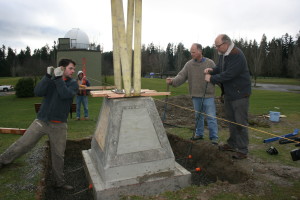
Seattle Astronomy was excited to get a note over the weekend announcing that the Battle Point Sundial Project is nearing completion. The Battle Point Astronomical Association (BPAA) reports that its spectacular, 12-foot-tall equatorial bowstring sundial should be installed near its Edwin E. Ritchie Observatory in Battle Point Park on Bainbridge Island within the next few weeks, depending on the delivery schedule of the sundial’s fabricator.

The foundation is prepared for the Battle Point Astronomical
Association equatorial bowstring sundial. From L-R: Dylan
 Sievertson (PHC Construction, built the foundation); Nels
Johansen (BPAA Vice Pres); David Browning (Sundial Engineer);
Bill Baran-Mickle (Sundial Artist/Designer). Once the
foundation was aligned and leveled, more concrete was
poured around it to lock it in place. The Edwin E. Ritchie
Observatory is in the background. Photo: Malcolm Saunders.
The BPAA has had this project on the drawing board for a long time. After slowly collecting funds over the years at their planetarium shows and other events, they reached a critical mass two years ago. Committed volunteers started to drive the project, and in late summer of 2013 they launched an Indiegogo campaign to raise $17,000 to bring their kitty up to the $30,000 they needed to build the sundial and install it in the park. The campaign drew some 75 donors, including Seattle Astronomy, and though it fell somewhat short of its goal, the attention the campaign attracted drew other outside funding, including a $1,000 grant from the North American Sundial Society, and BPAA amassed enough cash to move ahead with the project.

Their original goal was to have the sundial installed and dedicated by last spring, but they ran into some delays as sometimes happens with construction projects. They’re on track now with the foundation in place and ready for sundial delivery, and the sundial itself is fabricated and painted and ready to roll.

The sundial will be more than just a celestial timepiece. It will be a work of art and a conversation starter, and it will be a focal point for the BPAA’s facilities, which include the Ritchie Observatory, home of the 27.5-inch Ritchie Telescope and the John H. Rudolph Planetarium.

March 16, 2014

Seattle as sundial capital of North America

“I am passionate about sundials,” says Woody Sullivan, professor of astronomy at the University of Washington. “I have a goal to turn Seattle into the sundial capital of North America.”

Most of us don’t think of Seattle as the capital of anything related to the Sun, and we’re especially grumpy about it in the midst of a relentlessly gloppy March. But Sullivan points out that the second half of our year has long, clear days, and he observes that while people in, say, Phoenix often seek to escape from the Sun, we celebrate it.

“In Seattle, when the Sun comes out you go running out to see your sundial!” Sullivan says.
Sullivan gave a talk titled “Sundials Around Seattle and Beyond: Fascinating Mixtures of Astronomy, Art, Design, and History” at a recent meeting of the Eastside Astronomical Society in Bellevue. While the designation of sundial capital is hardly an official one, Sullivan thinks Seattle is on the way because of its large collection of interesting, well-cared-for public sundials.

The sundial on a SW-facing wall of the University of Washington
Physics/Astronomy building was the first Sullivan helped
build and design, 20 years ago.
Sullivan’s academic interests include astrobiology, the search for extraterrestrial intelligence, and the history of astronomy. His passion for sundials came about almost by accident. When the UW was constructing a new physics/astronomy building in the early ’90s, he suggested that a sundial should be placed on one of its large, outside walls. The architects went for it, and Sullivan spent a couple of years supervising the design and installation of the sundial.

“This is what got me into sundials, and ever since my life has been changed,” he says.
Inspired by the design of a sundial at the Sorbonne in Paris, the UW dial is on a wall that faces southwest. That means it’s design is asymmetrical, “which I think is more interesting from an aesthetic point of view,” Sullivan says.

Sullivan notes that all good sundials have a motto, and the one for the UW dial is “What you seek is but a shadow.”

“I thought that was good for a university,” he says. “It feels like it’s making progress.”
In a nod to our northwest weather the dial also is inscribed with a little poem:
I thrive on the Sun
Can’t work in the rain
So if I’m beclouded
Please come back again.
There’s a wealth of information about the UW dial on the web, including a webcam.

If you visit a Seattle sundial you will notice that the it doesn’t agree with your watch.
“Sundials do not tell you clock time,” Sullivan explains. “Your watch is off because we keep the same time as the people in Spokane. That ain’t right! Solar noon”—the moment when the Sun is due south and highest in the sky—”happens there 20 minutes before it happens here.”

Sullivan helped design pancam calibration targets like this
one that also serve as sundials on the three rovers on Mars.
Sullivan gave us a look at numerous other sundials in the area, and he’s had a hand in the design and construction of many of them. They’re in parks and at schools and even on picnic tables. He supported the Battle Point Astronomical Association in its successful effort to fund a new sundial on Bainbridge Island which is scheduled to be completed this summer.

In addition to all of those here on Earth, Sullivan also helped design three sundials that are now on Mars. The rovers Spirit, Opportunity, and Curiosity all have targets that are used for color calibration of their cameras in light and in shade. Bill Nye the Science Guy, who is now CEO of the Planetary Society, saw a mockup of the target, a disk with a post in the middle of it, and immediately thought it should be a sundial. Nye got Sullivan involved in the design. Coincidentally, Tyler Nordgren, astronomer who keynoted the Seattle Astronomical Society‘s annual banquet in January, was also part of the team that put it together.

Woody Sullivan brought a variety of small sundial samples to his talk,
 and the conversation continued well past the end of his formal presentation.
There’s also a bit of baseball on the Red Planet. As Sullivan and Nye share a passion for baseball in addition to their love of sundials, they made weight-saving cutouts in the bases of the Mars dials in the shape of home plate. Seattle’s Museum of Flight has Sullivan’s copy of the Mars dial on display in its space gallery.

Sullivan’s talk was tremendously well received. One EAS member noted that she switched her scheduled night at the opera to be at the talk instead. Staff at the library at which the talk was held booted us out well after closing time, and even at that the discussion continued in the parking lot for a good 45 minutes more.

Check out Sullivan’s sundial trail website for a guide to visiting Seattle sundials.
Other reading:

October 20, 2013

All systems go for Bainbridge sundial project

A sundial project that the Battle Point Astronomical Association (BPAA) has had on the drawing board for years will become reality by summer if all goes as planned. A fundraising effort anchored by an Indiegogo campaign has been a success.

“We’re only about $150 short of where we need to be, so on the strength of that we’re moving ahead,” said Frank Petrie, a BPAA member who is heading up the sundial effort. “It’s a done deal.”

BPAA members, with artist Bill Baran-Mickle at the center,
pose with a model of the proposed sundial. BPAA photo.
Interestingly, the Indiegogo campaign fell well short of its goal, raising just $6,610 of the $17,000 needed to meet the project budget of about $30,000. Petrie said, however, that the campaign helped raise the overall visibility of the sundial project.

“A lot of donations came in outside of Indiegogo,” he said. “Even though we fell well short of our Indiegogo goal, all of this other money coming in outside of Indiegogo was able to bring us to the point where we successfully funded the project.”

The North American Sundial Society chipped in with a grant of $1,000 and several other significant private donations also were made.

“It was really gratifying to see how people stepped up and really got enthusiastic about the project and supported it,” Petrie said.

He gave a big nod to University of Washington astronomy professor Woody Sullivan, known in some circles as “Mr. Sundial.” Sullivan appeared in the video supporting the sundial campaign and also connected BPAA with the Sundial Society.

Bainbridge Island sculptor and metalsmith Bill Baran-Mickle is finalizing the design for the equatorial bowstring sundial, which will stand 12 feet tall. Petrie said the next steps are some engineering for the foundation for the sundial, which will be erected in Battle Point Park near BPAA’s Edwin Ritchie Observatory, then building the foundation, fabricating the sundial, and installing it.

“We hope to complete all that process by late spring, so hopefully we can have a dedication in late spring or early summer,” Petrie said.

Petrie added that additional contributions would be welcome. There’s a long-term plan to build a plaza at the sundial site, but that if enough donations are made in the coming months they could speed up the time line on that. Contributions can be made by check or online at the BPAA website. Earmark any contributions for the sundial project.

Petrie admitted that the original goal was pretty ambitious.

“It was a little daunting, but I’ve been really gratified. The Bainbridge Island community is good that way. They get excited about stuff like this,” Petrie said, adding that it wasn’t just islanders. “The response has been pretty overwhelming from all over. That’s been really nice.”

We look forward to attending the dedication of the sundial next summer if all goes as planned.

September 15, 2013

Bainbridge sundial project in home stretch

The shadow is moving on the Battle Point Astronomical Association (BPAA) as it seeks to raise the funds needed to build a large equatorial bowstring sundial near its Edwin Ritchie Observatory in Battle Point Park on Bainbridge Island. With a week left in the association’s Indiegogo campaign, they’ve raised $4,535 toward the goal of $17,000 needed to fully fund the project.

BPAA members, with artist Bill Baran-Mickle at the center,
pose with a model of the proposed sundial. BPAA photo.
BPAA is actually a bit closer to the target than that. Frank Petrie, a BPAA member and part of the sundial committee, says they’ve raised more than $3,000 outside of Indiegogo since they launched the campaign about a month ago. Positive coverage of the effort has no doubt helped; in addition to our Seattle Astronomy article, the sundial project has received notice from the Bainbridge Island Review and Kitsap Sun. A contribution of $1,000 came in from the North American Sundial Society, which features a story about the BPAA effort on its website.

The budget for the sundial is $30,000. With previously received donations and contributions that have come in during the Indiegogo campaign, Petrie says they’re now within $10,000 of making the sundial a reality.

Even if they don’t reach the Indiegogo goal, they’ll receive funds pledged (less Indiegogo’s cut), and Petrie says they’ll bank that and take on other fundraising efforts until they have enough.

Why not resolve that worry and help them out today? Visit the campaign site, watch their video, read about the project and excellent perks for donors, and contribute to this worthy project. The sundial will be a significant piece of public art that will be a conversation starter, and it may well help spark some interest in astronomy.

August 24, 2013

Bainbridge astronomers seek funding for sundial

The Battle Point Astronomical Association (BPAA) has been working for many years on a plan to build a sundial next to its Edwin Ritchie Observatory in Battle Point Park on Bainbridge Island.

“It has been in the master plan for the organization almost since the get-go,” says Frank Petrie, a BPAA member since 1996 who is part of the sundial committee. The sundial would be built on a berm north of the association’s observatory and would be visible throughout much of the busy park.

BPAA members, with artist Bill Baran-Mickle at the center,
pose with a model of the proposed sundial. BPAA photo.
The project took a major leap toward reality with the launching of an Indiegogo crowdfunding campaign earlier this month. Petrie says the aim of the campaign is to raise the $17,000 they need to fully fund the sundial.

The budget for the spectacular, 12-foot-tall, bronze-clad steel equatorial bowstring sundial, designed by Bainbridge metalsmith Bill Baran-Mickle, is $30,000. BPAA has collected about $13,000 toward the project over the years from the donation jar at their monthly planetarium shows and community events, a pledge from its board, and recent grants from the Bainbridge Island Metro Park and Recreation District and the Bainbridge Community Foundation. The latter, Petrie says, indicated to BPAA that there was widespread community interest in the sundial.

“There’s interest in this project coming from the arts community as well,” he says, because of the renown of Baran-Mickle and the desire for more public art at Battle Point.

Woody Sullivan, a University of Washington astronomy professor also known as “Mr. Sundial,” makes a pitch for the project in the BPAA’s video on Indiegogo.

“Sundials connect you with the cosmos,” Sullivan says in the video. “They connect you with a more natural kind of time than a digital, flashing watch. They tend to slow you down, also, which is something I think we need in our 21st Century iPhone existence.”

Petrie says the sundial is a first step in BPAA’s ambitious vision for its astronomy programs at Battle Point Park.

“Our hope is to build an astronomy-related complex around our observatory in Battle Point Park,” he explains. “We have a number of features that we’d like to incorporate, and the sundial is one of those features.”

Another is an adjacent building for BPAA’s planetarium. Monthly planetarium shows are presently wedged into the Helix House, which also houses the observatory. But the space is small and cramped, and typically far more interested people show up than can be accommodated, forcing many to wait for a second show, or miss out.

“It’s been very, very popular, and that tells us that our long-term plan to expand is a good one,” Petrie says.

The popularity is well-deserved; BPAA puts on a good show. Seattle Astronomy recommends them highly.

Petrie calls the BPAA and its facilities “a little jewel” and says he loves the organization’s commitment to its mission.

“It’s dedicated to public outreach and getting folks interested in science,” he says. “We like to share the excitement that we have about science in general and astronomy in particular, and hope that we can reach as many folks as possible and get them excited as well.”

You can help share the excitement by contributing to BPAA’s Indiegogo campaign for the sundial.