Showing posts with label Stephanie Anderson. Show all posts

March 12, 2020

Goldendale Sky Village gives amateur astronomers dedicated observing site

Amateur astronomers in the Seattle area have been dreaming of a clear, dark place from which to observe the heavens since the clouds rolled in and light pollution obliterated much of the night sky. Those dreams are coming true at the Goldendale Sky Village just east of that south central Washington town.

It's dark at Goldendale Sky Village! This image
made at the site was created by Mark Vinup.
The Goldendale Sky Village (GSV) is owned by a limited liability company (LLC) of the same name, made up of members with interest in astronomy. The effort to establish the GSV is the end result of a search several decades in the making.

Most recently, the Seattle Astronomical Society (SAS) took a run at establishing a dark-sky observing site beginning in about 2005. Three years later, the project was tabled because the society couldn’t reconcile two desired criteria for the site: clear, dark skies and convenient proximity to Seattle. (I wrote about the end of the project for the April 2008 issue of the SAS newsletter, The Webfooted Astronomer.)

In 2016 Stephanie Anderson, a co-owner of Seattle’s Cloud Break Optics who was president of the SAS at the time, wanted to re-start the initiative and recruited SAS member Christopher Smythies, who is now the general manager of GSV, to head up the search.

Searching for the spot

“For two years I went out east of the mountains and familiarized myself with the land,” Smythies said. His focus was on two areas: Cle Elum and Goldendale. He found Cle Elum to be prohibitively expensive, and most parcels of land available for sale there were intended for housing and carried restrictions.

“Goldendale had a lot of attractive things about it,” Smythies said. “It was darker, the land was much cheaper, the rules were much looser, but it was further away.”

Smythies figures he must have looked at more than 100 properties over the course of a couple of years. By the time of the annual SAS Spring Star Party in May 2018 at Brooks Memorial State Park near Goldendale, he had a list of five of them for attendees to check out. The last of those that they visited is the one that is now Goldendale Sky Village.

“I immediately knew that was going to be it,” he said. “It was very remote, it was relatively flat, there were low horizons. It was pretty land; it wasn’t scrub land or pasture land, it was very attractive land with nice vegetation on it. And it was relatively cheap.”

“I thought it was perfect,” Smythies added. Unexpected bonuses include a line of sight to a communication tower that gives the site Internet access, and a great view of Mt. Hood to the west. There is federal land and open prairie nearby that will likely remain unoccupied, so future light intrusion isn’t a big concern.

LLC created for site

By this time the Seattle Astronomical Society had cooled to the idea of owning and operating a dark-sky site. Current president John McLaren said cost was a big concern. SAS would have had to do a major, multi-year fundraising effort or raise dues drastically to cover costs. Neither seemed likely to fly given the varying visions SAS members have for such a site. They considered trying to build a coalition with other regional astronomy clubs.

“That looked like it would be a legal headache,” McLaren noted. Running the site also would have created administrative tasks, including IRS reporting, that would have placed a burden on the club. The SAS board opted out.

“At that point, I decided to go another route to form a private group of people, an LLC, and then make it available to the SAS later on,” Smythies said. In June he put out a call for possible investors in the site.

“Within six weeks, two of which I was on vacation, we had 21 people saying ‘I’m in,’” he said. Smythies believes that a turning point for the project was when Anderson and Cloud Break Optics co-owner Matt Dahl signed on.

“She and Matt have such a good reputation for being kind of the hub of the astronomy community because of Cloud Break Optics, that once they said they wanted to be a part of it it was like a stamp of approval and everyone else piled on,” he said.

Astronomy can be hard work! Goldendale Sky Village
members clear rocks from the future telescope field, the
National Dark Sky Portal. Photo: Christopher Smythies.
Original members paid $1,000 per share in the new LLC. That entitled them to the use of their own 2,500 square-foot parcel within the village. They sold more than 100 shares and by the end of July had the cash to buy the land. The purchase became final in September 2018.

Since then they’ve made improvements to the road into the property, created parking space, and moved “a billion” rocks and boulders to create a smooth place for the village’s central telescope field, known as “The National Dark-Sky Portal.” They’re planning for improvements that include a big tent, the Red Light Lounge, for sharing refreshments and for shelter from the elements. Work this summer may include bringing electricity to the site as well.

It takes a village

Smythies says the village aspect of the GSV is vitally important.

“I wanted to put together something where people have lots, sure, but then there’s common areas right in the middle where they put their telescopes out and they observe together,” he said. This differs from some large astronomy communities where people might build a home on a two-acre plot. “Goldenndale sky village is all close together to promote the community atmosphere and the learning.”

While the GSV is a private company they intend to invite guests often. They hope to be ready by this year to host the SAS and its spring and fall star parties, and would like to build a similar relationship with the Rose City Astronomers in Portland, which is actually closer to the site. Smythies dreams of an astrophotography school and other educational efforts at the village.

The SAS hasn’t given up on creating observing sites. McLaren, who is a member of GSV, said SAS members also crave a dedicated site within 30 minutes of the city and one perhaps in the Cle Elum or Ellensburg areas, that might offer better observing conditions and still be relatively convenient. He hopes the Goldendale Sky Village model can be a good template for creating more observing sites.

“That would be awesome if it happened,” McLaren said, “and if some day astronomy clubs were able to negotiate access to all three locations that would be amazing.”

Smythies says there is room for perhaps 60 to 70 members at Goldendale Sky Village. The current price to join is $2,500 per share with a minimum of four shares. You can check out the site at an open house on March 21. Contact Smythies if you’re interested.

August 2, 2015

Astronomy store Cloud Break Optics opens in Ballard

For the first time that anyone can remember there is a retail shop run by and for amateur astronomers selling telescopes and astronomy gear in the City of Seattle. Cloud Break Optics opened quietly in Ballard a couple of weeks ago and is gearing up for a grand opening celebration later this month.

Matt Dahl and Stephanie Anderson with
one of their light buckets in front of their
telescope shop, Cloud Break Optics, in
Ballard. Photo: Greg Scheiderer.
Cloud Break Optics is owned and operated by Stephanie Anderson and Matt Dahl, longtime friends and Colorado transplants who got their start in the business working at a telescope store in the Denver area. They ended up in Seattle because of astronomy, education, and love.

Both have some impressive credentials. Anderson, who got interested in space after reading an Isaac Asimov book as a kid, majored in math and physics and taught at Metropolitan State University and the University of Colorado Denver. She was working as a guide on a solar eclipse tour in 2009 when she met her future husband, a Seattle resident.

“Our first date was three weeks in China and Tibet,” Anderson said. They started up a long-distance relationship between Denver and Seattle but, one December when Anderson’s adjunct contract at Metropolitan ran out, she didn’t renew and moved to Seattle.

Dahl received his first telescope for Christmas when he was 17, and was hooked after one look at the Moon. Later Anderson sold him his first larger telescope. He started college as a music major, but eventually switched to physics.

“Basically it’s been all downhill from there,” he joked. Dahl did research on extrasolar planets and, after college, got a job at the Laboratory for Atmospheric and Space Physics in Boulder and worked on the Kepler mission. In 2012 his wife was admitted to a master’s program at Bastyr University in Kenmore, and they moved to Seattle. It was a bit easier having a friend, Anderson, already in town.

An astronomy hiatus

Dahl and Anderson gave up on astronomy for a while after moving to Seattle; after all, we have our reputation as a cloudy and rainy place. But a trip to the Rocky Mountain Star Stare last summer reignited their interest. They went to the Table Mountain Star Party as well last year, and some old ideas resurfaced.

“Throughout our friendship we’d always kicked around this idea of owning a telescope store,” Dahl said. Late last summer, they decided to do it. Anderson explained there were two main factors that led to their leap.

“One was the realization that you really don’t actually have to go that far in the wintertime in order to have a nice, clear sky,” she said. They figured out local weather patterns and learned that things were better in Eastern Washington. “We realized we really weren’t traveling further than we were in Colorado to get a good, dark sky.”

The second was a practical matter that sprung from their renewed interest in observing.

“We really didn’t have a place we could go locally,” Anderson said, to make a quick pick-up of a key piece of gear they needed for an observing session. “We thought there would be a niche to fill.”

Experience counts

A big part of that niche is their personal knowledge and experience, according to Dahl.

“We each have hauled many a telescope from one location to another, and observed with different types of telescopes, imaged with different types of telescopes,” Dahl said. “We have a slew of knowledge in our back pockets. A lot of astronomy is getting that jump start from somebody who had done it before.”

“If your first observing experience is a pleasant one because you know how to operate your telescope and you have an instrument that will show you what you think it will show you, you are far more likely to stay in the hobby,” he added.

Anderson noted that sometimes the personal touch is the only way to go.

“A German equatorial mount is very confusing to someone who has never seen one before,” she said. “It’s almost impossible to learn on your own. You need someone to show you and explain what the theory is behind it.”

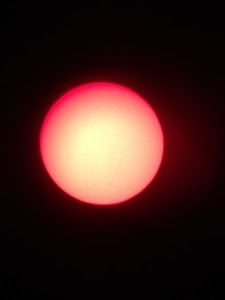
The author shot this photo of the Sun using an
iPhone attachment to a solar scope set up in the
Cloud Break Optics parking lot.
Photo: Greg Scheiderer.
The hands-on approach is important. As we talked about their plans for the shop we discussed astrophotography and the challenges I’ve had getting good photos with my smartphone. We soon had a solar telescope set up in the Cloud Break Optics parking lot and I was taking pics with the help of a nifty phone attachment. You get a better sense for the various telescopes and gear when you can actually see them, touch them, and use them. You just can’t get that experience online.

The challenges of a brick-and-mortar store

Anderson and Dahl recognize that a huge chunk of the sales of astronomy gear these days happens online, and so they are doing Internet sales and shipping globally.

“We have to compete in that market,” Dahl explained. “At the same time we wanted to provide a customer service experience” for people local to the Seattle area.

“We want them to come into the shop, talk to us, give them the advice and the expertise and the knowledge that we have,” he said. “At the same time we can provide as much of that as possible on our website.”

You can follow Cloud Break Optics on Twitter, Facebook, and Instagram. Drop by the shop at 2821 NW Market Street in Ballard, and watch for news of their upcoming grand opening celebration. They’ll be at Table Mountain again next week, this time with their vendor hats on. We expect they’ll work in a little observing as well.