April 14, 2015

Battle Point sundial project nearing completion

Seattle Astronomy was excited to get a note over the weekend announcing that the Battle Point Sundial Project is nearing completion. The Battle Point Astronomical Association (BPAA) reports that its spectacular, 12-foot-tall equatorial bowstring sundial should be installed near its Edwin E. Ritchie Observatory in Battle Point Park on Bainbridge Island within the next few weeks, depending on the delivery schedule of the sundial’s fabricator.

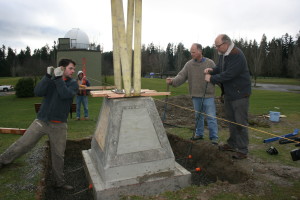
The foundation is prepared for the Battle Point Astronomical
Association equatorial bowstring sundial. From L-R: Dylan
 Sievertson (PHC Construction, built the foundation); Nels
Johansen (BPAA Vice Pres); David Browning (Sundial Engineer);
Bill Baran-Mickle (Sundial Artist/Designer). Once the
foundation was aligned and leveled, more concrete was
poured around it to lock it in place. The Edwin E. Ritchie
Observatory is in the background. Photo: Malcolm Saunders.
The BPAA has had this project on the drawing board for a long time. After slowly collecting funds over the years at their planetarium shows and other events, they reached a critical mass two years ago. Committed volunteers started to drive the project, and in late summer of 2013 they launched an Indiegogo campaign to raise $17,000 to bring their kitty up to the $30,000 they needed to build the sundial and install it in the park. The campaign drew some 75 donors, including Seattle Astronomy, and though it fell somewhat short of its goal, the attention the campaign attracted drew other outside funding, including a $1,000 grant from the North American Sundial Society, and BPAA amassed enough cash to move ahead with the project.

Their original goal was to have the sundial installed and dedicated by last spring, but they ran into some delays as sometimes happens with construction projects. They’re on track now with the foundation in place and ready for sundial delivery, and the sundial itself is fabricated and painted and ready to roll.

The sundial will be more than just a celestial timepiece. It will be a work of art and a conversation starter, and it will be a focal point for the BPAA’s facilities, which include the Ritchie Observatory, home of the 27.5-inch Ritchie Telescope and the John H. Rudolph Planetarium.

March 21, 2015

General relativity explained

Cool news from the Seattle Astronomical Society, which just announced that the program for its April meeting will be a talk by Dr. Jeffrey Bennett, author of What Is Relativity?: An Intuitive Introduction to Einstein’s Ideas, and Why They Matter (Columbia University Press, 2014).

Bennett has spent much of the last 30 years at the University of Colorado, where he remains an adjunct research associate with the Center for Astrophysics and Space Astronomy. These days he is mainly a writer and he has embarked on a “Relativity Tour” this year, celebrating the centennial of Einstein’s revolutionary ideas. Bennett’s basic premise is that general relativity is not all that difficult to grasp, and his goal is to bring relativity out of the realm of obscure science and help us understand it and the impact it has on our lives.

Oddly enough, it appears that my cats understand relativity. Followers of the Seattle Astronomy Facebook page recently saw the photo below of their demonstration. People trying to help others understand general relativity often ask them to imagine a bowling ball on a bed sheet. In this case Archie and Theodolinda used themselves as the massive objects, and the down comforter represents space-time. The green object in the background may be Neptune.

Bennett’s explanation may not be simple enough for cats to understand, but it is advertised as suitable for anyone from middle school on up. Bennett has taught young kids, and in addition to scholarly textbooks and science tomes for adults, he has written a series of children’s books featuring the outer space adventures of Max the dog. To gear up in advance of the talk pick up What Is Relativity? by clicking this link or the photo above. Links to Bennett’s other books are below.

The Seattle Astronomical Society talk will be at 7:30 p.m. Wednesday, April 15 in room A102 in the Physics/Astronomy Building at the University of Washington in Seattle. In addition to SAS, the Relativity Tour is sponsored by Big Kid Science, Columbia University Press, Fiske Planetarium, and Story Time From Space.

More materials

Jeffrey Bennett website

Books by Bennett


March 14, 2015

Gamma ray bursts, galaxies, exoplanets, and beer

Back in 1979 when I was an undergraduate at the University of Washington I took an introductory course in astronomy to fulfill some science credit requirements. The two Voyager spacecraft had just visited Jupiter and the faculty in the astronomy department seemed practically giddy about all of the new data received and textbook re-writing to come. These days, given the number of exciting missions returning information from the near and far reaches of the solar system, it seems we’re learning something new about the cosmos almost every day.

Case in point: earlier this week a trio of UW astronomy graduate students put on the first Astronomy on Tap event in Seattle, each giving a mini-lecture about their current research. Two of them had news fresh out of the headlines.

Zapped by gamma rays

Kristen Garofali was first up with a talk titled “To GRB or Not to GRB.” The GRB in this case stands for gamma ray burst.

There was a full house Wednesday at Bad Jimmy’s in Ballard for
the first Seattle Astronomy on Tap event. Photo by @AoTSeattle.
“Gamma ray bursts are cosmic lighthouses,” directional beams that Garofali explained result from the formation of a black hole. “When the black hole forms there are two jets of energy emitted that are really high-energy.”

Last week, for the second time in less than a year, scientists thought they had detected a GRB from our closest galactic neighbor, M31, the Andromeda galaxy. This would have been a first; we’ve never detected a GRB so nearby before. The nearest have been billions of light years distant, while M31 is a mere 2.5 million light years away from Earth.

Both the event last May and the one last week turned out not to be GRBs. Garofali noted that there are other objects out there that emit gamma rays, but these don’t look at all like whatever was detected coming from the neighborhood of M31 last week.

“It’s too bright to be a transient or an ultraluminous x-ray source,” she said. “It’s too faint, however, to be a gamma ray burst.” Even so, Garofali finds the discovery and the mystery exciting. “It could open our eyes to some new process that we haven’t thought about before,” she said.

Garofali said the reason we should care about this is that gamma rays are nasty things. At the very least, one would foul up your cell phone reception, and a strong burst could cause mass extinction on Earth. In fact, there is some scientific speculation that a GRB may well be responsible for at least one of the mass extinctions that have hit our planet. However, to do that the GRB would have to come from relatively close by and be aimed right at us. The odds of that happening are extremely long, but not zero.

Astronomy porn

Talk number two by Nell Byler was titled “Andromeda, So Fly, So PHAT.” She wasn’t using dated slang, but rather was talking about the Panchromatic Hubble Andromeda Treasury, a key tool for her work studying stellar populations. PHAT has taken up a lot of the Hubble Space Telescope’s time; the treasury was created from some 7,400 Hubble images involving 936 exposure hours. The collected data has resolved more than 117 million stars in our neighboring galaxy. The UW’s Julianne Dalcanton is the principal investigator for PHAT.

This PHAT portrait of M31 is a mosaic of more than 7,000
Hubble Space Telescope images. Photo: NASA; ESA;
 J. DALCANTON, B.F. WILLIAMS, AND L.C. JOHNSON/
UNIV. OF WASHINGTON; THE PHAT TEAM; R. GENDLER.
Byler showed a great deal of “astronomy porn”—stunning Hubble images from the project. They’re more than just pretty pictures; Byler said PHAT has the potential to reveal much about star formation, stellar evolution, and a host of other questions about how galaxies work.

“Even though we’re looking at stars within another galaxy it provides a lot of insight for galaxies that we can’t resolve and for our own galaxy, which we think is pretty similar to Andromeda itself,” Byler said. “And there’s lots more science to be done.”

Little green men

Brett Morris closed the evening with a talk titled “Dear Grandpa.” Morris is an astrobiologist, which his grandfather thinks is a pretty fishy undertaking involving the cover-up of the existence of extraterrestrials. Morris is hoping to find ETs, though, and on the very day of Astronomy on Tap the news wires were abuzz with new information about subsurface oceans on Jupiter’s moon Ganymede and on Saturn’s moon Enceladus, both of which could be havens for life. Kenneth Chang’s article in the New York Times provides excellent coverage.

Water vapor geysers erupt from the south pole area of
Saturn’s moon Enceladus. Photo: NASA/JPL.
“Enceladus has what we call cryovolcanoes; they’re volcanos that shoot out water,” Morris said.

“I personally think that this is the best chance to look for life elsewhere in our solar system because we can send a spacecraft that just orbits this moon and picks up the water as it shoots out of the moon,” he said. “Could it get more convenient? We don’t need to dig at all!”

Morris explained how the Kepler Space Telescope hunted for planets around other stars, though he bristled a little at the fact that when one is discovered similar in size to our home world it is invariably called “Earthlike.”

“Those have very broad, flimsy definitions,” he said, noting that Venus, which is practically our twin in size and mass, could be called Earthlike, but it would not be a nice place to visit. Morris is excited for scientific advances that will help us get a better idea of what exoplanets are truly like, and to identify which ones might harbor life like us.

The Astronomy on Tap event was well attended, with more than 60 people jamming into Bad Jimmy’s Brewing Company in Ballard (which pours a lovely IPA, by the way). The talks were well received and games were enjoyed, even though our team, nicknamed “Hubble Trouble,” did not win any cupcakes donated by Trophy Cupcakes. The organizers plan to be back with more events. Follow them on Twitter at @AOTSeattle. Also watch Facebook, where they hope to set up a page soon.

February 24, 2015

Sponsor will try again next year on light pollution study

We reported yesterday that a proposal to do a study of light pollution in the state of Washington was dead for this year’s session of the state Legislature. The prime sponsor of the measure says she plans to try again next year.

Rep. Jessyn Farrell of Seattle is the prime sponsor
of a bill calling for a study of light pollution
in Washington. Though the proposal is tabled for this
year, she plans to try again in 2016.
“I think this is an important issue,” wrote state Rep. Jessyn Farrell in an email to Seattle Astronomy, “but it’s going to take some time and education to get movement.”

Farrell’s bill is HB 2057, which was formally introduced Feb. 10 but did not receive a hearing or vote in the House Environment Committee. Last Friday was the deadline by which bills had to earn committee approval in order to remain eligible for further consideration this year.

The bill is just over one page in length, and simply would have directed the state Department of Ecology to “analyze the current extent of light pollution that adversely affects the quality of the environment, the value of property, and the health and well-being of the public,” and to recommend solutions to the problem. Though it didn’t get much consideration this year, we believe it is the first time the subject of light pollution has been raised in six years. Our post about the introduction of the measure includes a bit of history of the debate in Olympia.

The International Dark-sky Association and its local chapter Dark Skies Northwest are aware of the measure, and with lead time may be able to help provide some of the education Rep. Farrell believes is needed. In the meantime the astronomy community can help raise awareness by contacting legislators to support the bill in particular and curbs on light pollution in general.

February 23, 2015

Proposal to study light pollution switched off

Less than two weeks after it was formally introduced in the Washington State House of Representatives, a bill that would have directed the state Department of Ecology to study light pollution and recommend possible remedies appears to be off the table for this year’s session.

Rep. Joe Fitzgibbon, chair of the state House
Environment Committee, did not schedule a
hearing on the light-pollution study bill.
The measure, HB 2057 sponsored by Rep. Jessyn Farrell of north Seattle, was referred to the House Environment Committee, but did not receive a hearing. Last Friday, February 20, was the Legislature’s self-imposed deadline for having bills out of committee if they are to be eligible for further consideration.

While the bill may be dead the idea is not necessarily so. Occasionally, bills can be revived through parliamentary procedures, or they can be amended onto other measures, though neither of those possibilities seem likely in this case. The directive could be attached as a proviso to the Department of Ecology budget. Were that to happen, we would not likely know about it until the budget proposals start coming out in a month or so.

If nothing happens for the rest of this year’s session, the bill will be automatically re-introduced again for the 2016 legislative session, though the timeline for the study would likely be pushed back a year as well if the measure is considered at that time.

It is difficult to gauge how serious the effort is to take a close look at light pollution in the state. Neither the prime sponsor of the bill, Rep. Farrell, nor the Environment Committee chair, Rep. Joe Fitzgibbon of West Seattle, have responded to Seattle Astronomy’s requests for information.

We will keep you posted if we learn more.