February 24, 2014

The destruction of Hogwarts and other science goofs in fiction

If Harry Potter’s Hogwarts existed in the real world and Professor Minerva McGonagall turned herself into a cat, it would blow the place to smithereens, according to Charles Adler, professor of physics at St. Mary’s College of Maryland. Adler, author of Wizards, Aliens, and Starships: Physics and Math in Fantasy and Science Fiction, spoke earlier this month at Town Hall Seattle. He said the school for wizards would be toast because author J.K. Rowling didn’t follow one of the basic laws of science.

“By transforming herself into a cat, she is not conserving mass,” Adler noted, figuring that the cat probably weighs at least 90 pounds less than does McGonagall.

“If you convert that into pure energy, what ever that means, how much energy does she have to get rid of to turn herself into a cat?” he asked. “The math is pretty easy: e=mc2. It turns out that basically you’ve got about 50 H-bombs of energy liberated when you do this. BOOM! There goes Hogwarts.”

Adler cuts Rowling some slack because the Potter books are pure fantasy. He is a big fan of science fiction and fantasy writing and says thinking about the accuracy of the science boosts his enjoyment of the genres. He doesn’t expect it to be completely accurate—it is fiction, after all—but he believes authors and their stories need to need to be reasonably grounded in reality.

“If you’re going to introduce something which is in variance with the laws of science, you have an obligation to explore how that idea is going to affect the world, how that idea is going to affect the story that you’re writing, how to make it consistent with everything else in the story,” Adler contended. “If you’re not doing that, you’re not really playing fair with the reader.”

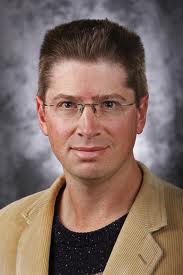
Chuck Adler. 
Photo: St. Mary’s College of Maryland.
Adler agrees with the approach of Poul Anderson, one of his favorite sci-fi writers to whom Wizards, Aliens, and Starships is dedicated. Anderson felt authors should use the laws of science to devise plausible settings for their stories.

“If you try to actually make your story obey the laws of science, at least mostly, you will have a better story, and it will also serve up ideas for how the story can go,” Adler explained.

Science fiction often runs into trouble with economics, according to Adler. In Star Trek, it would be preposterously expensive to produce enough antimatter to run just one starship, much less a fleet of them. There’s a practical problem, too.

“If we build a spacecraft like this anywhere near the Earth, merely turning the starship on will destroy the Earth” because of the gamma radiation it would emit, Adler said.

Even the food service raises questions. Adler said that making a cup of Earl Grey, hot, in the replicator for Captain Picard  would burn up enough energy to brew about two billion cups of tea.

“I’m not sure why they’re doing it this way on the Enterprise,” Adler said. “It looks cool, I will grant you that.”

We asked Alder to talk about authors who he thought got it right, who were almost visionary in coming up with gadgets or story lines that became fact. His top-of-the-head list included Larry Niven, who came up with the notion of the cellular phone in his 1974 story The Mote in God’s Eye; Arthur Clarke, who came up with the idea of the communication satellite; and Olaf Stapledon, who turned out to have a great grasp of the scope of cosmological history.

Adler’s fascinating talk included lots of analysis of space travel and human exploration, the engineering challenges of building space elevators, and a lot of math behind the science and magic of sci-fi and fantasy. The book includes even more analysis of the science in science fiction.

February 9, 2014

Half the park is after dark

Tyler Nordgren wears many hats: astronomy professor, author, artist, photographer, national park curriculum designer, and night-sky ambassador. The author of Stars Above, Earth Below: A Guide to Astronomy in the National Parks was the keynote speaker at the recent annual banquet of the Seattle Astronomical Society.

Tyler Nordgren
Nordgren, a professor of astronomy and physics at the University of Redlands in California, pegs his early interest in astronomy to his suburban-Portland grade school principal, who happened to be the uncle of astronaut Bonnie Dunbar. Mr. Dunbar used his connections to bring NASA folks to the school for talks. Nordgren decided then that he wanted to be an astronaut, too. Then he was amazed by Carl Sagan’s TV series.

“When I saw Cosmos I realized why I wanted to be an astronaut, or if not an astronaut, to be an astronomer,” Nordgren said.

Coincidentally, Nordgren attended graduate school at Cornell University when Sagan was on the faculty. He never took a class from Sagan, but in one of his first teaching gigs Jeremy Sagan, Carl’s son, was in Nordgren’s class. He said Jeremy sat in the front row, asked a lot of questions, and then talked over the lectures with his famous dad. No pressure there.

“I learned to be on my toes!” Nordgren joked.

Nordgren’s posters like this one for
Chaco Culture National Historical Park
help call attention to the importance
of dark night skies in the parks.
A couple of events inspired Nordgren’s work in the national parks, which includes marvelous photography and a series of travel posters based on the style of the 1930s WPA graphics. The first was a visit to Palomar Observatory.

“My very first telescope was an eight-inch Celestron my father bought for me when I graduated from college,” Nordgren recalled. “My second telescope was the Palomar 200-inch” which he used in research about dark matter in spiral galaxies. When he returned 10 years later he was taken aback by the increased light pollution fueled by a housing boom in the area.

“It had been like a tidal wave of light had just swept out around the mountain,” he said. “It was stunning just how bad the skies now were at Palomar.”

Shortly after that trip, Nordgren celebrated gaining tenure by taking a trip to Yosemite National Park and attended an evening ranger talk about astronomy.

“For many, many people this was the first time they had seen a night sky, a truly pristine night sky,” Nordgren marveled.

He decided to spend an upcoming sabbatical in the National Park system helping rangers develop programs for park visitors to experience the night sky. He spent time in a dozen different parks over the course of 14 months, and came to realize that the preservation of the land that prevents development in the parks also, almost by accident, preserves the precious resource of truly dark skies. It’s a growing part of the appeal of the parks, articulated by the slogan “Half the park is after dark.”

“In those parks that offer night-sky programs the attendance they have is equal to if not better than the next two types of programs added together,” Nordgren noted. “Far and away these are the most popular ranger programs that are offered.”

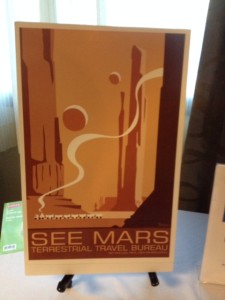
Nordgren's Mars poster
Much of Nordgren’s work is to link what people can see in the sky to what they see in the national parks. For example, he compares Mars to parks in the American Southwest; both Earth and the Red Planet have similar geology and chemistry. Yellowstone National Park has numerous geysers, similar to those on Saturn’s icy moon Enceladus.

One of Nordgren’s favorite parks is the Chaco Culture National Historical Park in New Mexico, which was recognized last year as an International Dark Sky Park by the International Dark-Sky Association. He noted that many of the ancient structures there serve as astronomical markers ala Stonehenge.

“People paid attention to the sky, people have been doing that for centuries, millennia,” Nordgren said. “Unfortunately we’ve made it tremendously difficult to keep doing that.”

As evidence he showed a photo of the sky above Chaco, which is still impressively dark and starry, but all around light pollution is encroaching from the cities of Gallup, Crownpoint, Albuquerque, and a nearby coal mine. Thus a big part of his aim is to get communities near the parks to recognize that the night sky is an attraction, and to encourage them to be good stewards of the dark sky. His spiel goes just as well for any city, regardless of its proximity to a national park.

“All that light that shines above the horizon doesn’t do anything useful,” Nordgren said. “So why are we lighting up the sky? There is nothing we need fear up there, so why are we paying for that light? Why are we generating that light? Why are we burning the natural resources to create that light?”

There really aren’t great answers to those questions, and Nordgren said the solutions are within reach.

“This can be a win-win situation for all of us,” he said. “We can get the stars back, we can save money, we can save natural resources. It really doesn’t have to be stars versus safety.”

Check out Nordgren’s posters and other artwork on his website.

January 27, 2014

Someone you know will travel in space soon

Leaders of four private, Northwest-based commercial spaceflight companies got together earlier this month at the Museum of Flight to talk about what we will see in their industry in the coming year. While they have some fascinating events on the docket for 2014, the conversation got most interesting when they talked about the not-much-more-distant future.

“I think we will expand out into space faster than people might realize,” predicted Chris Lewicki, president and chief engineer of Planetary Resources, Inc. “It’s less than five years, I think, before everyone in this room will know someone who has been higher than 100 kilometers.”

L-R: Erika Wagner of Blue Origin, Chris Lewicki of Planetary
Resources, Roger Myers of Aerojet, and Phil Brzytwa
 of Spaceflight, Inc. spoke Jan. 18 at the Museum of Flight
about the future of space exploration.
Erika Wagner, business development manager of Blue Origin, said the destination is cool, but the passenger list is even better.

“Where we’re going next is more exciting than ever because space and the whole frontier is becoming democratized,” Wagner said. “It’s no longer the realm of billion- or trillion-dollar economy nations, or even of millionaire tourists; it’s getting to the point where everyone in this room can have access to space in their own way.”

Wherever anyone is going Aerojet Rocketdyne is probably helping them get there. Dr. Roger Myers, executive director for advanced in-space programs at the company, noted that “rockets from Redmond” have powered many space missions, including Cassini at Saturn and the New Horizons spacecraft that will arrive at Pluto next year.

“There’s a lot going on in 2014 and beyond,” Myers said. “There’s a great future in this business.”

Myers said that true exploration of space is going to require a variety of rockets, other propulsion systems, and transportation options.

“If we’re going to expand the human economic sphere, if we’re going to become a species that exists beyond low-Earth orbit, we’re going to have to have a transportation infrastructure that mimics what we have on the Earth,” he said.

Aerojet has rocket engines on the recently launched MAVEN spacecraft headed for Mars, and also designed engines for the Orion craft, which is scheduled for an unmanned test flight this year. Blue Origin is busy testing its BE-3 liquid-hydrogen engine. Planetary Resources anticipates the launch of its first ARKYD space telescope this year, thanks in part to a Kickstarter fundraiser last year. While others build rockets, Spaceflight, Inc. is working to get your package delivered to orbit.

“We want to become the kayak.com or the UPS providing delivery of cargo to space,” said Phil Brzytwa, head of sales and business development for the company. “We want our customers to be able to pay by the seat not pay for the entire launch vehicle.”

Spaceflight, Inc. works the details and can send up numerous small satellites, cube-sats, and other smaller projects as part of a single payload, making things less complicated for everyone.

Many folks still find personal spaceflight and asteroid mining to be pretty far-fetched concepts, but Lewicki said we should not be so shocked at the rapid advance of technology.

“One hundred fifty years ago there wasn’t an internal combustion engine, and the idea of a steam-powered train was high-tech, and was getting us rapidly across the countryside faster than a horse could,” he noted. It didn’t take so long to get to horseless carriages and lighter-than-air flying machines. Lewicki doesn’t think affordable space travel and mining the solar system for resources are alien concepts.

“If we can conceive of it we can make it happen,” he said. “There’s nothing in the laws of physics that says these things aren’t possible. It’s just a matter of bit-by-bit finding the best use of them, finding the markets and the economies that drive the need for them, and then making them scalable enough so that everyone can benefit from them.”

“We are living during extremely exciting times, the likes of which will be written about in the history books,” Lewicki added, because “this is the time when our species got off the planet.”

January 6, 2014

Spokane astronomer competes for title of King of the Nerds

Spokane astronomer Kayla LaFrance hopes to help run missions to Mars or even walk on the Red Planet herself one day. Her short-term goal is to be recognized as one of the nation’s top geeks. LaFrance, a member of the Spokane Astronomical Society, will be a contestant on the second season of the television show “King of the Nerds,” which airs on TBS beginning Jan. 23. It’s not just a title; the person proclaimed monarch of dweebiness will receive a prize of $100,000.

Kayla LaFrance. Photo courtesy of
Trae Patton, Turner Entertainment Networks.
LaFrance isn’t your garden-variety nerd; while she describes herself as a “typical kid out of college with no career,” she has legitimate astronomy credibility. In May 2012 she finished work on her master’s degree in space studies at the University of North Dakota, where she did independent research on the organization of Mission Control for the surface exploration of Mars. She earned a bachelor’s degree in engineering physics, with minors in mathematics and public relations, from Belmont University in Nashville, Tennessee.

Those raised on Sesame Street may be thinking that one of those things is not like the others, but for LaFrance the PR minor meshed well with her interests.

“Sidewalk astronomy has always been a huge part of what I really enjoy doing,” LaFrance explained. “I thought public relations would be a good way to help me hone my skills at the telescope—helping little kids get into astronomy, helping parents figure out what’s going on, dealing with conspiracy theorists—it’s been a very big part of my time with the astronomy club.”

The Astronomical League has recognized LaFrance for her enthusiasm for outreach, twice presenting her with its Jack Horkheimer Award for Exceptional Service by a Young Astronomer—a first place award in 2003, and second place in 2002. More than a decade ago, the league’s articles about the awards noted LaFrance’s plan to visit Mars.

Star Trek captured LaFrance’s fancy when she was a little girl, and she’s been hooked on space ever since. Her seventh-grade teacher at Greenacres Junior High in Spokane Valley, Thomas Herrmann, launched her on her astronomy trajectory.

“[He] challenged me to stop looking at just the TV and start looking at what was really up there,” LaFrance said of Herrmann. “He showed me stuff with his telescope and started everything.”

She joined the Spokane Astronomical Society shortly thereafter and has been an active participant ever since, excepting for when she has been away at college. She frequently gives talks to the club, usually about Mars.

LaFrance made the cut for “King of the Nerds” last year, but passed when an even cooler opportunity presented itself. She scored an internship with the NASA Ames Academy for Space Exploration, where she did research on composites that represent science’s best guess about what Mars soil is like, based on data from various robotic missions. She was free for season two of the program, the producers were still interested, and she filmed episodes of the show last summer in Los Angeles.

“It was the best experience that I’ve participated in to date, and I’ve done some pretty cool stuff and seen some cool stuff,” LaFrance said. “I loved every moment of it. It was also the most challenging and stressful event of my life.”

LaFrance said her focus on Mars stems from her interest in human space exploration.

“The next logical step, in my opinion, is Mars, so I devoted a lot of my research time in college to the purpose of sending humans to Mars,” she said. “I’ve long been fascinated my Mission Control and how they operate and how they support crews in space. Of course if I could go into space I would definitely do it, but ultimately I would like to be flight director for missions on Mars.”

LaFrance plans to pursue a Ph.D. degree some day, but figures she needs more practical experience first, so will be looking for work with government or private agencies involved in aerospace and mission operations.

In the meantime, watch for her on “King of the Nerds.” The program, hosted by Robert Carradine and Curtis Armstrong, two of the stars of the 1984 film “Revenge of the Nerds” and its sequels, airs Thursday nights beginning Jan. 23. It will be on at 10 p.m. in Spokane, but, as they say, check your local listings. Keep an eye on Mission Control, too. I wouldn’t be surprised to see LaFrance turn up there sooner than later.

December 21, 2013

A look back at coverage of ISON

I had to smile with the arrival of the January 2014 issues Astronomy and Sky & Telescope magazines earlier this month. The cover of the former heralded “Comet ISON’s Final Stab at Glory,” while the latter proclaimed “Comet ISON’s Final Act.” Richard Talcott’s article in Astronomy was subheaded “This cosmic visitor should remain a fine binocular object as it skims near the North Star during its retreat from the inner solar system.” Editor Robert Naeye’s piece in S&T proclaimed “Comet ISON might be putting on a gorgeous display as you read these words… or maybe not.”

Both magazines arrived in my mailbox about a week after ISON went “poof” after passing within 730,000 miles of the surface of the Sun on Thanksgiving Day.

The fact that both publications carried articles about something we already knew wasn’t going to happen by the time the issues arrived in our mailboxes serves to illustrate the challenge of monthly print magazines trying to cover breaking news. The approaches of the writers revealed a bit about the editorial bent of the magazines. I decided to take a look back at how they covered ISON over the past year.

Astronomy was the first of the first of the two
major magazines to write about ISON, and made the
comet its cover story in November 2013.
Even though ISON was discovered in late September of 2012, the first mention of it in print didn’t come until the December issue of Astronomy, in which senior editor Michael E. Bakich wrote, “About a year from now, Comet C/2012 S1 (ISON) may well become the brightest comet anyone alive has ever seen. Just how bright it will get is currently a subject of debate.”

S&T didn’t mention ISON until January 2013, when the cover proclaimed “The Comets are Coming,” and contributing editor John E. Bortle, who has been writing about comets for the magazine since 1967, wrote “whether [ISON] will become a great comet remains unclear,” and he chided the “Internet wags” (guys like me) for their poor understanding of typical comet behavior and wild speculation and hype about ISON’s potential. That same month in Astronomy Bakich again used the “anyone alive” line, and channeled Spiro Agnew and William Safire when he noted in his article that “The nattering nabobs of negativism already are downplaying expectations. I, for one, am not drinking from their half-empty glass.” One wonders if he got an advance peek at Bortle’s copy.

There wasn’t much written about ISON for the next few months, though comets LINEAR and PanSTARRS got some coverage during the late winter and early spring. S&T stepped in with a little downward adjustment of expectations in April. Naeye wrote that predictions of ISON’s spectacular potential were premature.

“With our decades of experience covering such matters, we know better at S&T.” The issue also included an article looking back at the much-hyped Comet Kohoutek, the mid-1970s “dud of the century.” After that S&T would not spill one drop of ink on ISON until August.

Astronomy was more active in its coverage. In June David J. Eicher wrote about comets in his “From the Editor” column, using the “anyone alive” line from Bakich but also stressing how unpredictable comets can be. Eicher write about ISON and other comets in his column in six of the next eight issues, breaking only to note the magazine’s 40th anniversary and its website re-design. His “Snapshot” column at the head of each issue’s news section was about comets in four of those eight months.

There wasn’t much else in either of the magazines for the rest of the summer. Astronomy ran a monthly note in the Comet Search section of its observing guide each month beginning in July, and S&T added ISON notes to its observing section starting in August.

Sky & Telescope put ISON on
 its cover in December 2013.
The pace picked up a bit in September. Bortle wrote in S&T that “Some have been billing ISON as ‘the comet of the century.’ Is there a chance this won’t be an embarrassment?” Richard Talcott’s article in Astronomy that month also used a question mark on “comet of the century,” though the subhead noted ISON was “still two months from glory.”

In October S&T was dead silent on ISON, while Astronomy kicked it into gear. Talcott wrote a four-page article about viewing ISON during its approach, and Joseph Marcus wrote six heavily illustrated pages about “What Makes a Great Comet?”

Sky & Telescope showed more enthusiasm in November. Naeye wrote about ISON but continued to warn “Anybody who tries to give you definitive brightness predictions months in advance is either playing the hype game or doesn’t understand the unpredictable nature of comets.” The magazine also ran an eight-page article about great comets, written by Joe Rao, and some detailed observing charts and instructions. Astronomy went all-in, with a November cover story—"Comet ISON Blazes Into Glory”—and other features on the science of comets, superstition about comets, the anatomy of a comet, and a history of bright comets.

December was the month in which having to write about the news before it happened really became a pinch. Talcott’s story in Astronomy carried the sub-head “After a harrowing pass by the Sun late last month, this cosmic interloper should remain a grand sight throughout these long December nights.” S&T made ISON its December cover story, with articles by Bortle, who kept with his story line about the unpredictability of the matter, and others writing about comet science, viewing guides, and tips for taking images of comets. Both magazines had photo contests up and going.

Finally, January and the let-down. We learned just after Thanksgiving that ISON had disintegrated while skimming the Sun, before our January magazines hit the mailbox the first week of December. The final act was over before the curtain even came up.

The different approaches the two publications took to their ISON coverage are interesting. In one sense Sky & Telescope was “right.” It warned from the start that comets are unpredictable and that we shouldn’t get our hopes up too much. Astronomy made that warning, too, though it generally took a more hopeful approach and devoted far more space to ISON than did S&T, using the opportunity to write more about comets in general.

By this time you may be asking how Seattle Astronomy covered ISON. The answer is that we didn’t, making just one mention in a post back in May about the possibility of using ISON as a way to get people interested in astronomy. We passed along breaking ISON news and speculation on Facebook and Twitter.

The saving grace for the monthly magazines is that they, too can use their websites and social media to cover breaking news that is impossible to catch in print versions that go to press more than a month ahead of their mail dates. They have to write something, but it’s a particular challenge to deal with such unpredictable critters as comets.

Some amateur observers got a peek at ISON, and scientists made many observations and learned a lot more about comets, so in that sense it wasn’t a “dud.” But unfortunately ISON didn’t come close to becoming the spectacle we’d hoped for when its sungrazing nature was first recognized more than a year ago. We’re still waiting for the comet of the century.