October 10, 2015

Science and art meet in planetary nebulae

The next time someone tells you that science and art don’t mix, point them to the work of the Hubble Space Telescope. Hubble images are the inspiration for a multimedia concert, “Origins: Life and the Universe,” coming up at 2 p.m. November 7 at Benaroya Hall in Seattle. Astronomer Bruce Balick and composer Nan Avant explained during a talk last week at the Museum of Flight how one segment of the concert was created.

Prof. Bruce Balick, in front of a slide depicting Galileo,
talks about science and art at the Museum of Flight.
Photo: Greg Scheiderer.
Balick, professor emeritus in the Department of Astronomy at the University of Washington, noted that science is, to a great extent, the result of our unique human ability to recognize patterns.

“Science is observing the world around us and describing the pattern, typically with mathematical formulas,” Balick said. “After that we puzzle over what these patterns might mean. We use the patterns as a means to gain insight into the way in which the natural world works.”

While Balick has spent his career studying planetary nebulae, he also loves the incredible images of those celestial objects that Hubble has returned to Earth.

“I want you to appreciate what I hope Nan has found in these pictures, namely glorious natural patterns that inspire music,” he said. “These objects are simply beautiful.”


Avant, a composer from Ballard, said the photos spoke to her.

Composer Nan Avant gestures while talking about
her creative process on “Bijoux.” Photo: Greg Scheiderer.
“I was so inspired by what I’d seen with these brilliant colorful images,” she said. In addition, she was influenced by conversations with Balick about the Orion Nebula and the Carina Nebula, the two objects that are featured in her multimedia composition, “Bijoux.”

“There’s so much going on in the nebula I wanted to continue this into my concept of the music, so I created many themes or melodies to represent the nebula,” Avant explained.

Avant said her last year, working on the project, has been “astounding.”

“As a composer, I’ve learned about the nebula, the universe. I had conversations with a distinguished scientist of the nebula. I collaborated with a filmmaker,” she said. “And finally, I composed an orchestral work about the universe. I grew so much as an artist, a composer, and an orchestrator.”

The title of the piece, “Bijoux,” is French for “jewels.”

“When I was looking through these breathtaking, stunning images and the music was unfolding into rich melodies and textures, I wanted to find a word, just one word, that expressed the music and images all in one idea,” Avant said of the choice.

“Scientists, musicians, artists, all of them have so much in common,” Balick marveled. “We love pattern. We appreciate pattern. Pattern says something to us. It may be visceral, it may be scientific. It comes in the form of music, it comes in the form of art.”

The “Origins” concert is part of the celebration of the 50th anniversary of the Department of Astronomy at the UW. The concert will feature the work of eight composers and accompanying celestial photography. It is a benefit for the scholarship program at the University of Washington Astrobiology Program in the Department of Astronomy. Tickets are $32, $22 for students, and are available online or by calling the Benaroya Hall ticket office at 206-215-4747.

Another chance to preview one of the pieces in the concert is coming up at 2 p.m. next Saturday, Oct. 17, at the Museum of Flight. Professor Matt McQuinn of the UW Department of Astronomy will take a close look at how our universe was formed and how small fluctuations in the cosmic microwave background grow into galaxies with stars and planets. Glenna Burmer, who composed a piece entitled “The Big Bang,” will discuss her musical and visual interpretation of the 13.8-billion-year history of our universe, exploring the process that composers and filmmakers use to bridge science and art. The talk, titled “Origin of the Universe and Everything in It,” is free with museum admission.

October 4, 2015

Simonyi shares space experiences at UW

Your Seattle Astronomy correspondent has at least one thing in common with software executive and billionaire philanthropist Charles Simonyi: neither of us expects to be able to receive spousal clearance for a flight in space. Simonyi has a couple of legs up, having already taken Soyuz flights to and from the International Space Station in 2007 and 2009.

Simonyi spoke about his experiences during a talk titled “Practicalities of Orbital Space Tourism” last week at the University of Washington. It was the first of a series of lectures scheduled this fall celebrating the 50th anniversary of the founding of the university’s Department of Astronomy.

Space tourist Charles Simonyi spoke about his experiences
during a lecture Sept. 29, 2015 at the University of Washington.
Photo: Greg Scheiderer.
Simonyi acknowledged that the cost of going into Earth orbit is prohibitive for almost every individual. Speculation is that he shelled out $25 million to go on his 2007 flight and another $35 million to return to the ISS two years later. On top of the financial cost, he spent eight months training for the first flight, learning the spacecraft, studying Russian, and going through a dizzying and often invasive series of medical tests and examinations. His second flight took just three months of training because he already knew a lot.

Would he go again?

“Now I have a family to think about,” Simonyi said, smiling at his wife seated in the second row of the lecture room at Kane Hall.

“I would have to do eight months training again,” he said, because the Russians are using a different spacecraft. “I think I’m getting too old for that. It’s not easy and that would be a big obstacle.”

Still, the draw is great.

“Let’s assume the price didn’t go up, they didn’t require training, my wife lets me go,” he said to laughter. “I would do it!”

Simonyi said a big reason he wanted to fly in space was to support space exploration. Space tourists pumped more than $100 million into the Russian space program at a time that it was strapped for cash. He also did it to popularize science, he said, though interestingly he’s a bit skeptical about sending humans to space to do science because of the enormous cost. The believes simple wanderlust is a great reason to go into orbit.

“A tourist is a very honest broker. The tourist says, ‘Send me to space and I will pay you,'” Simonyi noted. “I think space tourism will be a major factor in promoting space travel because of this self-justifying property that it has.”

This Soyuz capsule TMA-14, which took Charles Simonyi to
the International Space Station in 2009, is on display at the
Museum of Flight. Photo: Greg Scheiderer.
Some astronauts get a big thrill at the moment of launch into space, but Simonyi found it to be fairly routine to be sitting in the capsule at blastoff.

“It’s not as dramatic as you think from the inside,” he said. “From the outside it’s incredible; I’ve seen it. From the inside it’s like being in an elevator and somebody pushed the button.”

It’s hard to say when space tourism will fall into the price range of those of us whose net worths are less than Simonyi’s $1.4 billion. He noted that these days it costs about $10,000 to send a kilogram of mass into orbit. If the price could be driven down to about $100 per kilogram, then a space tourist might get to orbit for $100,000, which Simonyi called a “reasonable ticket.”

“That’s what the suborbital people are basically pricing their services at,” he noted. “It’s a lot of money, but if it’s a once-in-a-lifetime experience I think people would consider it seriously.”

“Those numbers are not here, and they’re not going to be here for quite a while,” Simonyi said. “That is the bad news.”

September 7, 2015

Predicting some big astronomical kabooms

X-ray binaries are out in the universe making gravitational waves, and Breanna Binder says we may well be on the verge of being able to detect such waves generated in distant star systems. Binder, a recent University of Washington astronomy Ph.D. who did her dissertation about the evolution of X-ray binary systems, gave a talk on the subject at the August meeting of the Seattle Astronomical Society.

Dr. Breanna Binder gave a talk about
X-ray binary systems at the August
meeting of the Seattle Astronomical
Society. Photo: Greg Scheiderer.
Binder noted that it’s a bit of a longshot for an X-ray binary system to form. They start out as a pair of stars ten times or more massive than our own Sun.

“Almost all massive stars are born in binary systems,” she said. “Not only that, massive stars are more likely to be born with massive companions.”

However, these massive stars live relatively short lives and ultimately explode in supernovae. The more massive the star, the more rapidly it evolves, and so the larger of two massive stars in a binary system will be the first to expand into a blue giant. The more it expands, the weaker its gravitational pull on its outer atmosphere will be, enabling the smaller companion to steal some of its mass.

Eventually the larger of the pair goes supernova and leaves behind a compact object: either a neutron star or a black hole. This is often the end of the binary system, as only about one in 10,000 pairs remain gravitationally bound after the supernova. If they do stick together, that’s when the fireworks really get going. The sibling star, having siphoned off some of its companion’s mass, also begins to grow into a blue giant.

“As this happens, material flows from the giant star onto the compact object,” Binder explained, “and when this happens the system starts to heat up. All that material funneling onto the compact object gets incredibly hot and begins to glow in X-rays.”

These are easy for us to spot from Earth.

“These objects will emit X-rays at levels that are tens of thousands to millions of times above what a normal star like our Sun does,” Binder noted.

This high-mass X-ray binary phase doesn’t last long in astronomical terms, perhaps just 10,000 years or so. Eventually the second star goes supernova.

“If the system survives the second supernova explosion, which is a big if, you end up with two compact objects in orbit around each other,” Binder explained. While two neutron stars is the most likely formation, it can also be two black holes or one of each, she said.

With two neutron stars in a system they spiral rapidly around each other, creating powerful gravitational waves. Eventually the two objects merge, creating a big explosion that we can see as a gamma-ray burst. This is the aftermath of the merger of two neutron stars, and it’s also where the new science comes in.

“In the very near future, we’re hoping to be able to detect neutron stars in the process of spiraling into each other before the gamma-ray burst occurs,” Binder said. We will do that by actually detecting gravitational waves using LIGO—the Laser Interferometer Gravitational-Wave Observatory.

The challenge with LIGO is that there’s a lot of noise out there. Anything that moves through space generates gravitational waves. In its first runs LIGO in Richland was able to detect motion from ocean waves breaking on the Washington coast. So scientists have been busy modeling and tweaking, and expect to make the first science runs of a new version of LIGO some time this fall.

“If we’re going to detect gravitational waves, it’s going to happen as soon as we bring advanced LIGO on,” Binder said. “It could easily be within the next year that we are able for the first time to directly detect gravitational waves from the source.” That will give us some early warning about where to look to spot future gamma-ray bursts.

Ultimately the study of these systems will help us better understand stellar formation and evolution.

August 23, 2015

UW's Foucault pendulum out of action

We were sad to see on a recent visit to the Physics/Astronomy Building on the University of Washington campus in Seattle that the university’s Foucault pendulum is out of commission. According to the sign on the railing around the pendulum:

I have been damaged possibly due to vandalism. My mounting support bracket and cable are both damaged and need to be replaced. I don’t know when this can happen yet. I’m sorry I can’t swing gently for you at this time and I know people miss me. 

Given the nature of the damage, we wonder if some dimwits tried swinging from the pendulum.

We hope the pendulum is repaired soon. If blog hits are any indication, people are interested in Foucault pendulums. A post we wrote 2011 about the world’s largest Foucault pendulum, in the convention center in Portland, Oregon, is consistently among the top ten viewed on Seattle Astronomy.

August 2, 2015

Astronomy store Cloud Break Optics opens in Ballard

For the first time that anyone can remember there is a retail shop run by and for amateur astronomers selling telescopes and astronomy gear in the City of Seattle. Cloud Break Optics opened quietly in Ballard a couple of weeks ago and is gearing up for a grand opening celebration later this month.

Matt Dahl and Stephanie Anderson with
one of their light buckets in front of their
telescope shop, Cloud Break Optics, in
Ballard. Photo: Greg Scheiderer.
Cloud Break Optics is owned and operated by Stephanie Anderson and Matt Dahl, longtime friends and Colorado transplants who got their start in the business working at a telescope store in the Denver area. They ended up in Seattle because of astronomy, education, and love.

Both have some impressive credentials. Anderson, who got interested in space after reading an Isaac Asimov book as a kid, majored in math and physics and taught at Metropolitan State University and the University of Colorado Denver. She was working as a guide on a solar eclipse tour in 2009 when she met her future husband, a Seattle resident.

“Our first date was three weeks in China and Tibet,” Anderson said. They started up a long-distance relationship between Denver and Seattle but, one December when Anderson’s adjunct contract at Metropolitan ran out, she didn’t renew and moved to Seattle.

Dahl received his first telescope for Christmas when he was 17, and was hooked after one look at the Moon. Later Anderson sold him his first larger telescope. He started college as a music major, but eventually switched to physics.

“Basically it’s been all downhill from there,” he joked. Dahl did research on extrasolar planets and, after college, got a job at the Laboratory for Atmospheric and Space Physics in Boulder and worked on the Kepler mission. In 2012 his wife was admitted to a master’s program at Bastyr University in Kenmore, and they moved to Seattle. It was a bit easier having a friend, Anderson, already in town.

An astronomy hiatus

Dahl and Anderson gave up on astronomy for a while after moving to Seattle; after all, we have our reputation as a cloudy and rainy place. But a trip to the Rocky Mountain Star Stare last summer reignited their interest. They went to the Table Mountain Star Party as well last year, and some old ideas resurfaced.

“Throughout our friendship we’d always kicked around this idea of owning a telescope store,” Dahl said. Late last summer, they decided to do it. Anderson explained there were two main factors that led to their leap.

“One was the realization that you really don’t actually have to go that far in the wintertime in order to have a nice, clear sky,” she said. They figured out local weather patterns and learned that things were better in Eastern Washington. “We realized we really weren’t traveling further than we were in Colorado to get a good, dark sky.”

The second was a practical matter that sprung from their renewed interest in observing.

“We really didn’t have a place we could go locally,” Anderson said, to make a quick pick-up of a key piece of gear they needed for an observing session. “We thought there would be a niche to fill.”

Experience counts

A big part of that niche is their personal knowledge and experience, according to Dahl.

“We each have hauled many a telescope from one location to another, and observed with different types of telescopes, imaged with different types of telescopes,” Dahl said. “We have a slew of knowledge in our back pockets. A lot of astronomy is getting that jump start from somebody who had done it before.”

“If your first observing experience is a pleasant one because you know how to operate your telescope and you have an instrument that will show you what you think it will show you, you are far more likely to stay in the hobby,” he added.

Anderson noted that sometimes the personal touch is the only way to go.

“A German equatorial mount is very confusing to someone who has never seen one before,” she said. “It’s almost impossible to learn on your own. You need someone to show you and explain what the theory is behind it.”

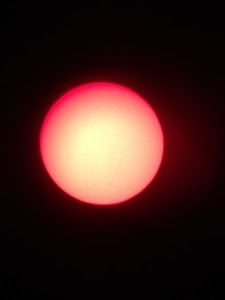
The author shot this photo of the Sun using an
iPhone attachment to a solar scope set up in the
Cloud Break Optics parking lot.
Photo: Greg Scheiderer.
The hands-on approach is important. As we talked about their plans for the shop we discussed astrophotography and the challenges I’ve had getting good photos with my smartphone. We soon had a solar telescope set up in the Cloud Break Optics parking lot and I was taking pics with the help of a nifty phone attachment. You get a better sense for the various telescopes and gear when you can actually see them, touch them, and use them. You just can’t get that experience online.

The challenges of a brick-and-mortar store

Anderson and Dahl recognize that a huge chunk of the sales of astronomy gear these days happens online, and so they are doing Internet sales and shipping globally.

“We have to compete in that market,” Dahl explained. “At the same time we wanted to provide a customer service experience” for people local to the Seattle area.

“We want them to come into the shop, talk to us, give them the advice and the expertise and the knowledge that we have,” he said. “At the same time we can provide as much of that as possible on our website.”

You can follow Cloud Break Optics on Twitter, Facebook, and Instagram. Drop by the shop at 2821 NW Market Street in Ballard, and watch for news of their upcoming grand opening celebration. They’ll be at Table Mountain again next week, this time with their vendor hats on. We expect they’ll work in a little observing as well.